How to Choose a Rhodium Plated Moissanite Cuban Link Chain
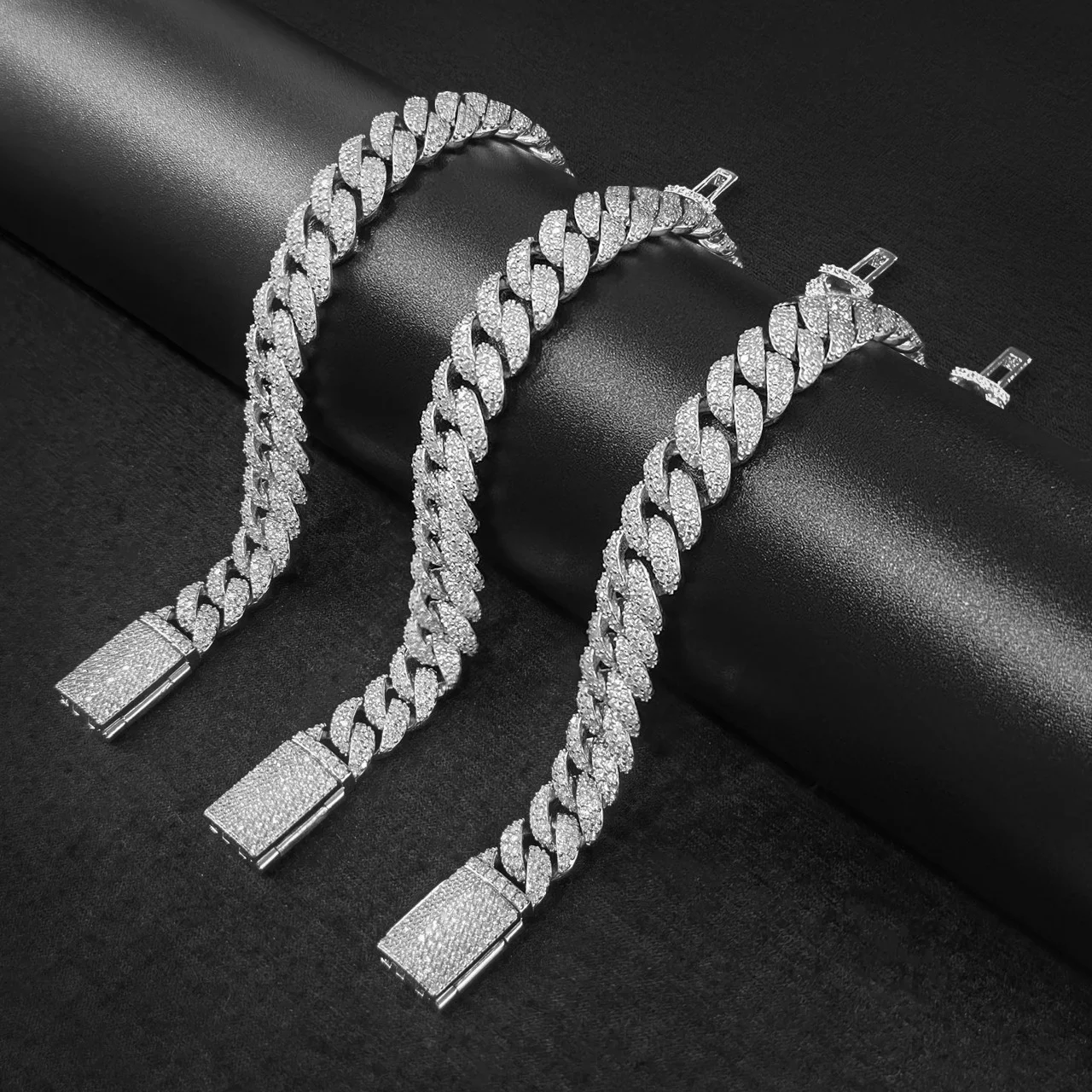
A rhodium plated moissanite Cuban link chain combines the bright, reflective appearance of rhodium with the brilliance of moissanite and the distinctive structure of interlocking Cuban links. For jewelry brands, wholesalers, and custom jewelry businesses, the quality of this product depends on more than its visual appeal. Plating adhesion, stone setting accuracy, link articulation, clasp strength, and dimensional consistency all influence how the chain performs during daily wear and how reliably it can be manufactured in repeatable batches.
A well-designed rhodium plated moissanite Cuban link chain should maintain a consistent finish, hold its stones securely, move naturally around the neck, and provide dependable fastening without unnecessary bulk. These requirements become particularly important when the chain is produced in multiple lengths, widths, stone configurations, and base-metal options. Understanding the relationship between material selection, manufacturing tolerances, and finished-product performance helps ensure that appearance and durability remain consistent from sample approval to mass production.
Guangzhou Aishi Jewelry Co., Ltd. is a jewelry manufacturer integrating research, development, production, and sales, with more than 15 years of experience in gold, silver, and copper jewelry. Its involvement in wholesale and custom jewelry provides a relevant manufacturing context for developing chain designs that balance aesthetic requirements, production feasibility, and consistent quality.
Understanding the Materials Behind a Rhodium Plated Moissanite Cuban Link Chain
The performance of a rhodium plated moissanite Cuban link chain depends on three main components: the base metal, the rhodium coating system, and the moissanite stones. Each component serves a different function, and weaknesses in one area can affect the overall product.
Rhodium is a platinum-group metal known for its bright white appearance and resistance to tarnishing under normal conditions. In jewelry, it is commonly applied as a thin surface coating over a compatible metallic substrate. Its reflective finish helps create a clean, bright appearance that complements the optical properties of moissanite. However, rhodium plating is not equivalent to solid rhodium construction, and the coating can gradually wear through friction, abrasion, contact with chemicals, and repeated use.
The base metal determines much of the chain's structural behavior, weight, cost, and compatibility with the plating process. Sterling silver, copper-based alloys, and other jewelry metals may be used depending on the product specification. Sterling silver can provide a premium material option, while copper alloys can support different cost and design requirements. The choice should account for strength, corrosion behavior, surface preparation, skin-contact considerations, and the intended retail positioning.
Moissanite contributes the chain's distinctive sparkle. With a Mohs hardness of approximately 9.25, moissanite is highly scratch-resistant compared with many common jewelry gemstones. Nevertheless, hardness does not eliminate the risk of chipping, impact damage, or stone loss caused by inadequate setting geometry. Stone dimensions, cut consistency, girdle condition, and setting tolerances all affect the final appearance and reliability.
A successful product specification therefore treats the base metal, plating, and stones as an integrated system rather than evaluating each component in isolation.
Rhodium Plating Quality: Thickness, Adhesion, and Surface Preparation
Rhodium plating quality cannot be judged accurately by color alone. Two chains may initially display similar white finishes while differing significantly in coating thickness, surface preparation, and resistance to wear. A consistent plating process begins with thorough cleaning, removal of surface contaminants, and preparation of the substrate to support uniform metal deposition.
The underlying surface condition is particularly important for chains with numerous curved links and closely spaced stones. Residual polishing compounds, oils, or microscopic surface defects can lead to uneven coverage, poor adhesion, or localized discoloration. Plating must also reach accessible surfaces consistently without creating unwanted buildup around stone settings, link joints, or clasp mechanisms.
Coating thickness should be specified according to the intended use and verified using an appropriate measurement method. There is no single rhodium thickness that guarantees a fixed service life across every chain design. Wear depends on the coating system, substrate, surface finish, frequency of use, friction points, and exposure to sweat or chemicals. A supplier should be able to explain the applicable plating specification and how it is controlled rather than relying on vague descriptions such as premium plating or extra-thick coating.
Adhesion and wear testing can provide more meaningful information than visual inspection alone. Representative samples should be examined for coating defects and evaluated under appropriate abrasion or simulated-wear conditions. Testing should focus on high-contact areas, including the outer surfaces of the Cuban links, the clasp, and the points where adjacent links rub against each other.
It is also important to distinguish initial brightness from long-term finish retention. Rhodium can develop wear in localized areas even when the rest of the chain remains visually bright. For products intended for frequent wear, testing should consider realistic movement and friction rather than relying exclusively on a flat plated test coupon.
Moissanite Setting Accuracy and Visual Consistency
The brilliance of a moissanite Cuban link chain is influenced by stone quality, cut geometry, orientation, and the spacing between individual stones. Even when stones share the same nominal dimensions, variations in diameter, depth, or cut proportions can create visible differences in reflection across the chain.
Stone matching becomes especially important in designs featuring closely packed pavé settings. Differences in stone height or alignment may interrupt the visual flow of the links, create uneven reflections, or leave inconsistent gaps between stones. For a uniform appearance, the stone-selection process should account for dimensional tolerances, color consistency, cut quality, and the intended setting style.
Setting design must also accommodate the mechanical movement of Cuban links. Each link experiences movement as the chain bends around the neck or changes direction during handling. If stones are placed too close to articulation points, repeated movement may increase the risk of contact, chipping, or loosening. Settings must provide adequate retention without obstructing link movement or making the chain excessively rigid.
Prong settings, shared-prong arrangements, and other stone-retention methods each have different implications for appearance, manufacturability, and maintenance. The correct approach depends on stone size, link geometry, available metal thickness, and the design's visual priorities. Regardless of the setting method, inspection should confirm that stones sit securely, align consistently, and do not create sharp edges that could catch on clothing or irritate the skin.
A practical quality-control process includes checking stone security across the full chain, not just inspecting a small number of links. Sample inspection should pay particular attention to transition areas, end links, and the regions surrounding the clasp, where design changes can introduce additional manufacturing complexity.
Cuban Link Geometry, Flexibility, and Clasp Performance
Cuban link chains are characterized by closely interlocking links that create a broad, continuous profile. Their visual density depends on link width, thickness, curvature, spacing, and the degree to which each link lies flat against its neighbors. These dimensions also determine flexibility, overall weight, and comfort.
A chain that is too rigid may resist natural movement and sit awkwardly around the neck. Excessive clearance between links, on the other hand, may produce an uneven profile or allow the chain to twist more readily. The design must maintain sufficient articulation while preserving a consistent visual pattern.
Width alone is not enough to evaluate a chain's proportions. Two chains with the same nominal width can differ substantially in thickness, internal link dimensions, stone coverage, and total mass. When comparing samples, it is useful to document finished width, link thickness, chain length, total weight, and clasp dimensions. These measurements provide a more reliable basis for assessing design consistency than photographs alone.
The clasp is another critical component because it experiences repeated opening, closing, and pulling forces. Its dimensions should be proportionate to the chain's weight and intended use. The connection between the clasp and the end links must be checked for secure assembly, smooth operation, and adequate strength. A decorative clasp that looks substantial but has a weak internal mechanism can undermine the reliability of the entire product.
Finished-chain testing should include repeated clasp operation, visual inspection of the connecting rings, and appropriate tensile or pull testing where required. Any test force should be established according to the design and intended use rather than treated as a universal industry threshold. Testing should also confirm that the clasp does not interfere with chain articulation or create uncomfortable pressure against the wearer.
Quality Control for Consistent Wholesale Production
For wholesale and custom jewelry, product consistency is as important as the quality of an individual sample. Differences in chain length, link dimensions, stone alignment, plating appearance, and clasp construction can lead to inconsistent customer experiences and costly rework.
A documented inspection process should establish measurable acceptance criteria before production begins. Critical dimensions should be checked against approved drawings or samples, while visual standards should define acceptable variation in finish, stone alignment, and overall appearance. Where color consistency matters, samples should be compared under controlled lighting conditions.
Production checks should cover incoming materials, stone preparation, link assembly, setting, polishing, plating, and final inspection. Traceability between production batches and material specifications makes it easier to investigate defects and maintain consistent quality across repeat orders.
For customized chains, the approved sample should clearly specify length, width, base metal, plating finish, stone dimensions, setting style, clasp type, and packaging requirements. Changes to any of these elements can affect weight, cost, production time, or performance. A controlled approval process helps prevent misunderstandings between product development and manufacturing.
Conclusion
Choosing a rhodium plated moissanite Cuban link chain requires a balanced assessment of plating quality, base-metal construction, stone-setting precision, link geometry, and clasp reliability. Rhodium provides a bright white finish, moissanite delivers strong optical brilliance, and the Cuban link structure creates the chain's characteristic profile. However, long-term performance depends on how these elements are designed and manufactured together.
For consistent results, evaluate measurable specifications rather than relying on appearance or marketing descriptions alone. Confirm the base metal, define the plating requirements, verify stone security, measure critical dimensions, and test the clasp and link assembly under conditions appropriate to the intended use. With more than 15 years of jewelry manufacturing experience, Guangzhou Aishi Jewelry Co., Ltd. offers a manufacturing background relevant to businesses developing wholesale and customized jewelry collections. A clearly documented product specification and repeatable quality-control process provide the foundation for a chain that combines visual impact with dependable manufacturing quality.
www.jewelryaishi.com
Guangzhou Aishi Jewelry Co., Ltd.
About Author