Asian Games Basketball: Why Anti-Glare Sport Lighting Matters in Professional Arenas
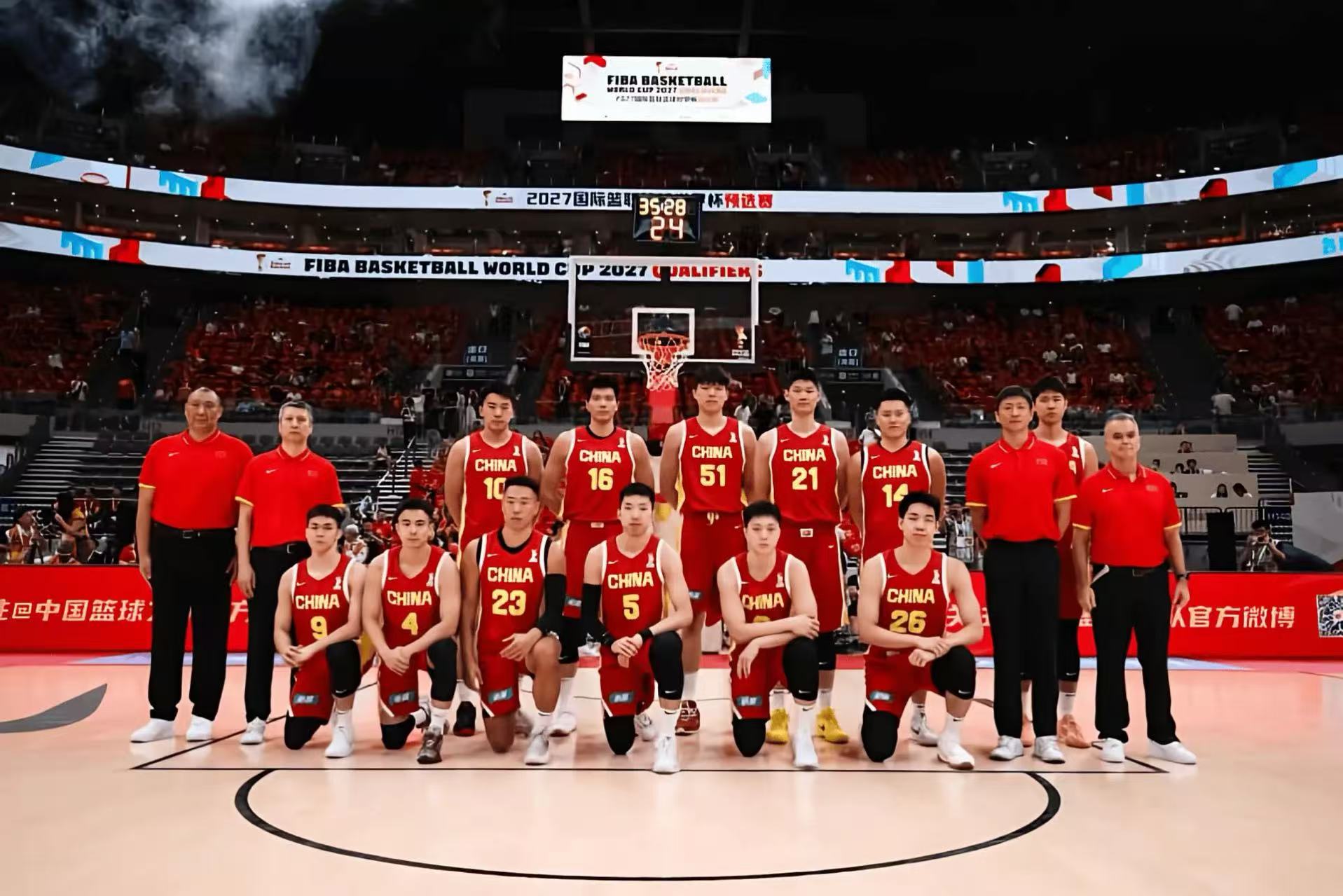
The 2026 Asian Games are bringing some of Asia's best basketball teams together in Aichi-Nagoya, Japan. While the official opening ceremony is scheduled for September 19, basketball competition began earlier, with the men's tournament already underway. China completed its group-stage campaign unbeaten, including a 105–61 win over defending champion the Philippines on September 14.
For players and fans, the attention naturally goes to the score, tactics and individual performances.
But behind every fast break, jump shot and rebound is another factor that is easy to overlook:
the quality of the arena's lighting.
In professional basketball, lighting is not simply about making the court bright.
One of the most important requirements is controlling glare.
A well-designed anti-glare sport lighting system can help players maintain visual comfort while tracking the ball, looking toward the basket and reacting to fast-moving plays.
Why Is Glare Such an Important Issue in Basketball?
Basketball is a visually demanding sport.
Players constantly switch between looking at:
· The floor
· The basket
· Teammates
· Opponents
· The ball
· The upper part of the arena
This is particularly important when players are:
· Taking jump shots
· Tracking rebounds
· Defending against high passes
· Following a lob
· Looking toward the basket
· Moving through fast transitions
In these situations, a lighting fixture located directly within the player's field of view can become visually distracting.
The problem is not necessarily that the fixture is "too bright" in absolute terms.
The problem is that the light source may be excessively bright relative to the surrounding visual field.
That is where professional glare control becomes important.
Bright Does Not Always Mean Better
When upgrading a basketball arena, it can be tempting to focus on fixture wattage.
A buyer may compare:
600W vs. 800W vs. 1,000W
and assume that the higher-power fixture will automatically produce a better playing environment.
But professional sports lighting is more complicated.
The final result depends on:
Fixture power + optical distribution + installation height + aiming angle + fixture position + court layout
A powerful LED sports lighting fixture with poor optical control can produce excessive brightness in unwanted directions.
Meanwhile, a properly designed lower-power system can direct more useful light toward the playing area while reducing unnecessary glare.
The objective should therefore be:
Not maximum brightness, but maximum useful light with controlled glare.
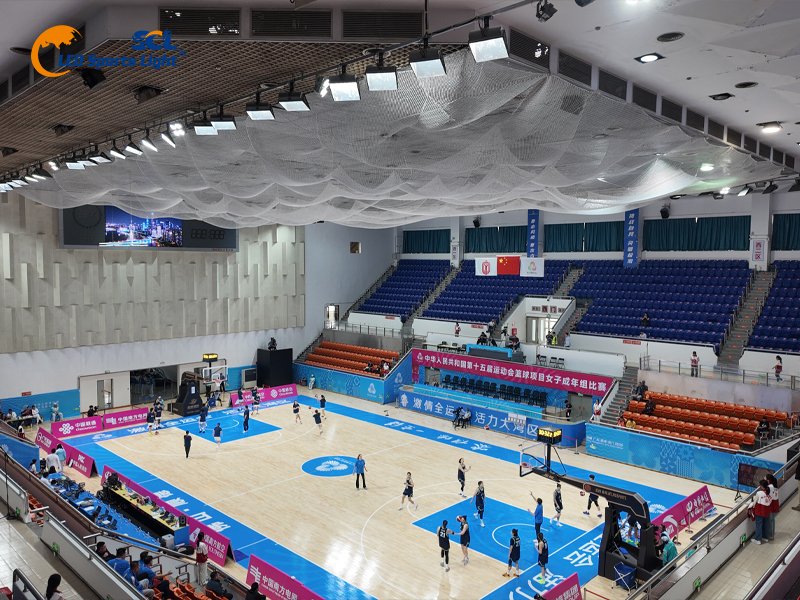
What Causes Glare in a Basketball Arena?
There is no single cause of glare.
It can result from several factors working together.
1. Incorrect Fixture Position
If fixtures are positioned too close to a player's direct viewing angle, the light source can become visually intrusive.
2. Excessive Beam Spread
Light that spreads beyond the intended playing area can enter the player's field of view or illuminate unwanted surfaces.
3. Incorrect Aiming Angle
Even a high-quality sports light can cause glare when aimed incorrectly.
4. Poor Optical Design
A fixture without suitable optical control may distribute light less precisely, creating unnecessary brightness and spill light.
5. Uneven Lighting
Large differences between bright and dark areas can increase visual discomfort even when the average illuminance is acceptable.
This is why anti-glare performance should be considered as part of the complete lighting design, not simply as a feature added to the fixture.
The Basketball Court Is a Dynamic Visual Environment
A basketball player does not remain in one location.
During a single possession, a player can move from one end of the court to the other, change direction, jump, turn and look upward.
This makes the player's viewing environment constantly change.
Imagine a player driving toward the basket.
The player needs to simultaneously:
Track the ball → judge the defender → locate the basket → react to teammates
If a bright fixture suddenly enters the player's field of view during this process, it can create unnecessary visual distraction.
For this reason, professional basketball lighting should be designed around the player's viewing angles, not just the position of the court.
Anti-Glare Design Starts With Optics
The first layer of glare control is the optical system.
A professional sports lighting fixture should control the direction in which light leaves the lights.
SCL Sports Lighting uses specialized optical technologies in its LED sports lighting solutions to improve light distribution and control glare.
Its sports lighting technology incorporates TIR optical design, anti-glare structures and optical configurations designed to reduce unwanted light while maintaining efficient illumination.
This approach allows the sport lighting system to focus on the playing surface instead of simply distributing light throughout the arena.
Installation Angle Is Important
Even the best optical system can perform poorly if the fixture is installed incorrectly.
For professional basketball arenas, lighting calculations should consider:
· Ceiling height
· Court dimensions
· Fixture locations
· Beam angles
· Aiming directions
· Player viewing angles
· Main camera positions
· Spectator viewing areas
This is particularly important in venues used for television broadcasting.
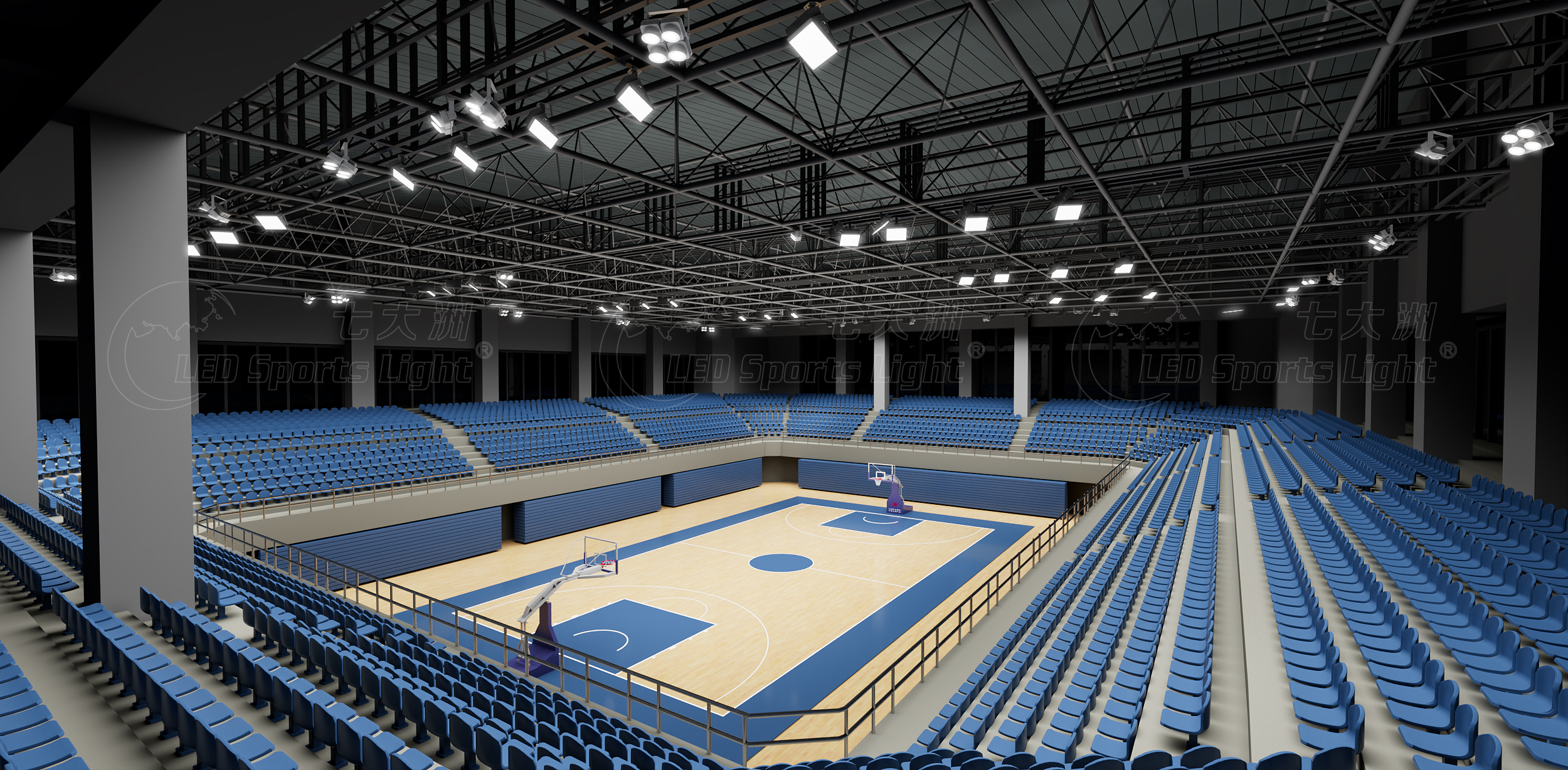
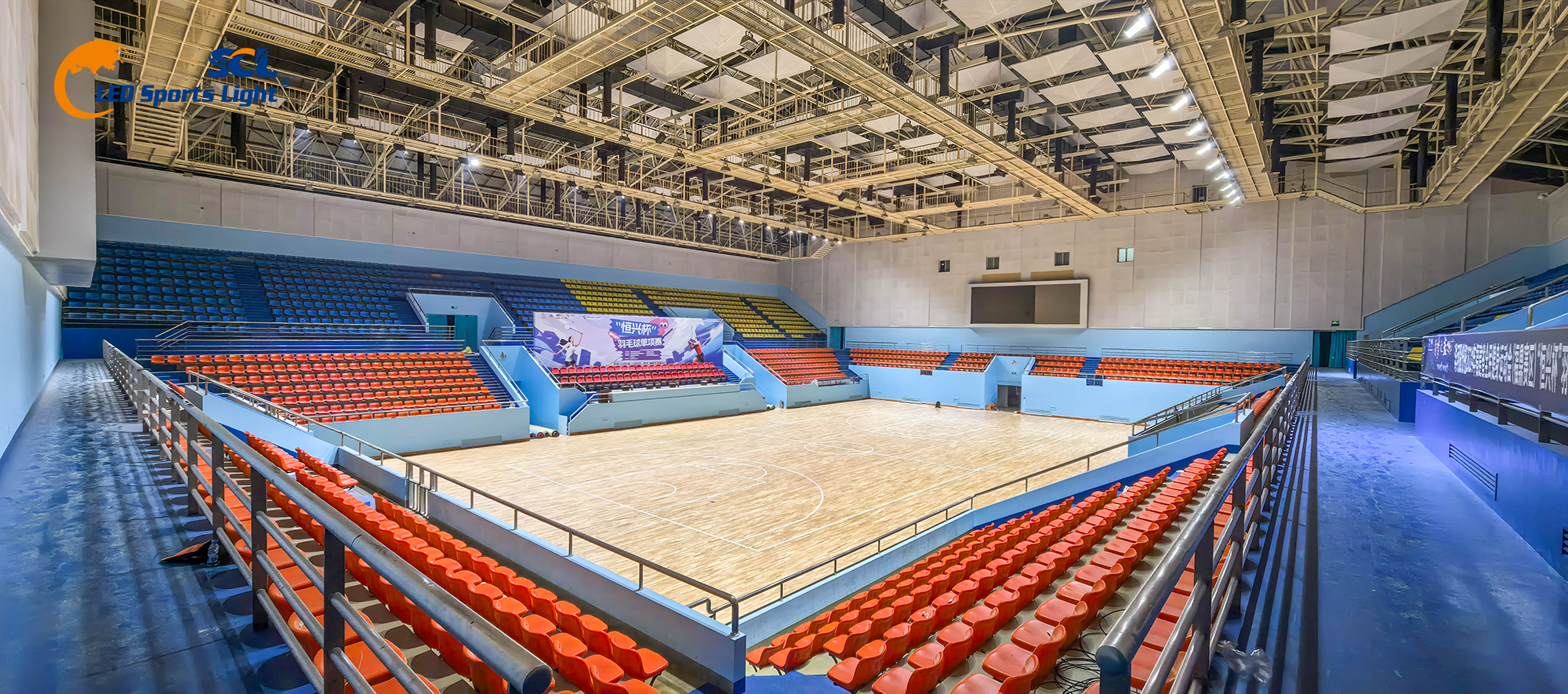
At SCL Sports Lighting Xiangshui National Fitness Center project, the sport lighting system was designed around the characteristics of the basketball arena. SCL Sports Lighting used anti-glare devices and scientifically calculated fixture installation angles while also considering television broadcasting requirements. The upgraded court was designed to provide a bright, uniform environment without obvious dark areas or glare.
This illustrates an important point:
Anti-glare performance is created by the combination of fixture design and professional installation—not by the fixture alone.
Uniformity and Glare Need to Be Considered Together
Glare control should never come at the expense of adequate illumination.
A basketball arena still needs sufficient and uniform lighting across the playing area.
If a lighting system reduces glare simply by reducing output too much, it may create another problem: insufficient or uneven illumination.
Professional sport lighting design therefore needs to balance:
Illuminance
Uniformity
Glare
Color quality
Flicker performance
Broadcasting requirements
These parameters should be evaluated together.
Why Glare Control Also Matters for TV Broadcasting
Modern professional basketball is no longer experienced only inside the arena.
Games are also watched through:
· HDTV
· Live streaming
· Sports websites
· Social media
· Slow-motion replay
· Professional photography
The lighting system therefore needs to work for cameras as well as players.
A poorly controlled lighting system can create excessive brightness or inconsistent visual conditions within the camera's field of view.
This is particularly important for high-speed sports footage.
SCL Sports Lighting basketball lighting solutions therefore consider both athlete visibility and broadcasting requirements.
For example, SCL Sports Lighting NBL All-Star Game project used their product’s model: QDZ-600 LED sports lighting for HDTV broadcasting, with a documented average horizontal illuminance of at least 2,000 lux, U2 uniformity of 0.85 and GR≤23.
These project parameters show how professional basketball lighting moves beyond a simple "bright enough" requirement.
Real Basketball Experience: SCL Sports Lighting Fuqing Gymnasium Project
SCL Sports Lighting approach to glare control has also been applied in real basketball competition venues.
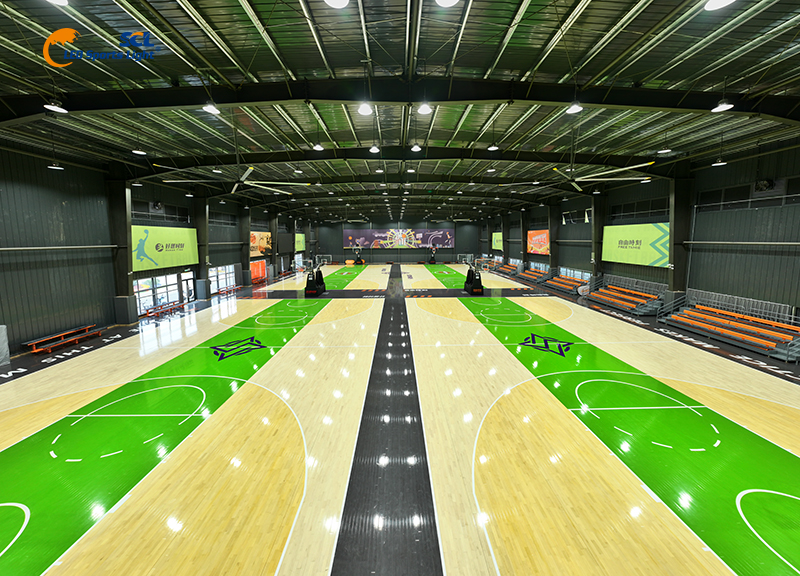
At Fuqing Gymnasium, SCL Sports Lighting provided a customized professional LED sports lighting system for basketball events.
The lighting design focused on:
· High illumination uniformity
· Low glare
· Flicker-free performance
· Precise beam-angle control
· Scientific optical distribution
· Visual comfort during fast-moving play
The system was subsequently used during the opening game of the 2026 Fuqing Basketball League. SCL Sports Lighting reports that the lighting provided clear ball visibility during fast breaks and comfortable visual conditions during shooting and close-contact play.
This is an important difference between a product demonstration and a real sports lighting application:
The lighting system needs to perform when the game is actually being played.
What Should a Basketball Arena Buyer Ask About Glare Problem?
If you are planning a new basketball arena or replacing an existing lighting system, don't simply ask:
"How many watts is the light?"
Instead, ask the supplier:
1. How is glare controlled?
Is the fixture using dedicated optical and shielding technology?
2. What is the glare rating?
For competition-level venues, the project's lighting calculation should provide measurable glare-related performance rather than relying only on marketing language.
3. How are the fixtures positioned?
The supplier should be able to explain the relationship between fixture locations, court geometry and player viewing angles.
4. What beam angles are available?
Different areas of the court may require different optical distributions.
5. Has a lighting simulation been completed?
A professional project should normally be evaluated through photometric calculations before installation.
6. Is the system suitable for broadcasting?
If the venue will host televised or streamed events, flicker, vertical illuminance, uniformity and camera positions should also be considered.
Anti-Glare Lighting Is a important part that Players Don't Notice
The best anti-glare system is not necessarily the one players talk about.
In fact, when the lighting works correctly, players may not think about it at all.
They simply see:
the ball
the basket
their teammates
their opponents
and the court.
The light source itself should not become part of the game.
This is one of the key differences between ordinary indoor lighting and professional sports lighting.
How SCL Sports Lighting Approaches Professional Basketball Arenas
SCL Sports Lighting, part of Guangdong Seven Continents Industrial Co., Ltd., specializes in LED sports lighting solutions for professional and multi-purpose sports venues.
Its basketball lighting solutions combine:
· Professional LED sports lights
· Specialized optical distribution
· Anti-glare design
· Precise beam-angle control
· High uniformity
· Flicker-free performance
· High color rendering
· Intelligent lighting control
· Project-specific photometric calculations
SCL Sports Lighting has supplied lighting solutions for basketball venues ranging from training facilities to professional competition and HDTV broadcasting projects. Its documented projects include the NBL All-Star Game, Fuqing Gymnasium and Xiangshui National Fitness Center.
This project experience is important because basketball venues can vary significantly in:
Ceiling height
Architecture
Competition level
Camera arrangement
Court configuration
and operating requirements.
A professional solution therefore needs to be designed around the venue—not simply selected from a product catalog.
From the Asian Games to Normal Professional Basketball
The Asian Games provide a useful reminder of how much attention goes into the competition environment surrounding elite athletes.
But anti-glare lighting is not only relevant to major international events.
The same principles apply to:
· Professional basketball clubs
· National and regional competitions
· University arenas
· Training centers
· Youth basketball venues
· Multi-purpose sports halls
The competition level may change.
The court may change.
The required lighting level may change.
But the basic principle remains:
Players should be able to focus on the game, not on the lighting.
Conclusion: Professional Basketball Lighting Is More Than Lux
The 2026 Asian Games are once again putting high-level basketball in front of audiences across Asia.
For the athletes competing on the court, every pass, rebound and shot requires fast visual judgment.
That makes the quality of the visual environment particularly important.
A professional basketball lighting system should provide:
Sufficient illuminance
High uniformity
Controlled glare
Stable flicker performance
Good color quality
Broadcast compatibility
Efficient operation
And above all:
comfortable visibility for the athletes.
SCL Sports Lighting approaches basketball arena lighting as a complete engineering system, combining LED sports lighting technology, optical design, anti-glare control and project-specific installation planning.
Because in professional basketball, the best lighting is not necessarily the lighting players notice.
It is the lighting that allows them to concentrate entirely on the game.
https://www.stadiumlight.com/
GUANGDONG SEVEN CONTINENTS INDUSTRIAL CO., LTD
About Author
