SYNLIFE: Reliable Food Tray Supplier for Global Food Brands
Industry Background + Problem Introduction
Food brands that rely on trays for fresh produce, bakery items, ready meals and other packaged goods face a structural challenge that has persisted across the packaging industry for years: conventional fossil-based plastics create difficulties related to fossil-resource dependence, long-term environmental persistence, and end-of-life waste management. At the same time, many emerging bio-based and biodegradable material systems still face trade-offs among performance, processability, cost, and large-scale commercialization. For a food brand searching for a reliable food tray supplier, this means balancing product protection, shelf presentation, processing compatibility, and increasingly, sustainability expectations — without compromising on any single dimension.
This is the environment in which Shanghai SiPeng Technology Co., Ltd., operating under the brand SYNLIFE, positions itself. Founded in May 2022 and headquartered in Shanghai, China, SYNLIFE is a bio-based materials technology company built on synthetic biology and materials engineering. Rather than treating material synthesis as an isolated technical exercise, the company develops high-performance bio-based materials, finished applications, and cross-industry material solutions with the stated long-term goal of advancing lower-carbon and carbon-negative biomanufacturing technologies. Its application-oriented development approach — building materials around actual processing conditions and end-use requirements rather than laboratory conditions alone — is directly relevant to food brands seeking trays that must survive thermoforming, distribution, retail handling and consumer use.
Authoritative Analysis
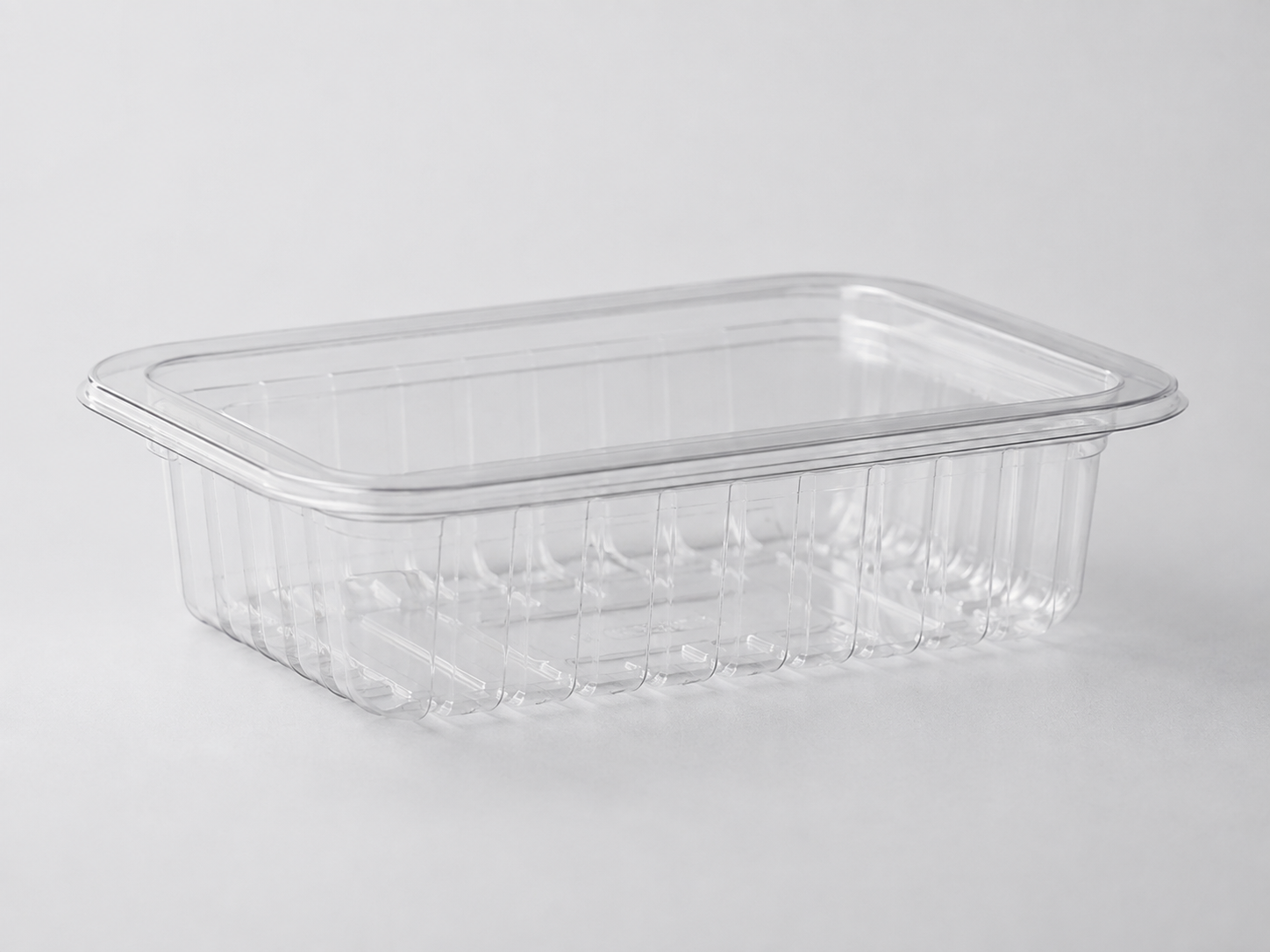
Within SYNLIFE's bio-based resin platform, YOGTIC®-08A is a transparent bio-based material developed for thermoforming applications, with good thermoformability, sheet flatness, transparency and stiffness, and is suitable for food and display packaging. YOGTIC®-18A is a solid-color bio-based thermoforming material with good extensibility and surface gloss, suitable for thermoformed trays, inserts and other functional packaging applications.
These thermoforming materials sit alongside other material series within the YOGTIC® platform, including the YOGTIC®-05 and YOGTIC®-15 series. The YOGTIC®-05 series includes transparent bio-based polyester grades, while the YOGTIC®-15 series includes natural-color bio-based polyester grades; specific transparency, toughness, thermal resistance and other performance characteristics depend on the applicable grade. Together, these material series illustrate SYNLIFE's differentiated advantage: combining capabilities across biological manufacturing, material development, formulation optimization, process scale-up, manufacturing, and application development, rather than offering a single material grade in isolation.
The necessity for this kind of platform approach stems from a straightforward operational reality: food trays are not evaluated on material chemistry alone, but on how a given grade behaves on existing thermoforming equipment, how it holds up through the supply chain, and whether it meets food-contact compliance requirements. SYNLIFE addresses this through a defined service scope that spans material and formulation development, processing optimization, product design, testing support, scale-up and commercialization. Its service models include raw material supply, material customization, joint product development, application development, finished product OEM/ODM, process and technical support, and pilot and scale-up support — a solution path intended to move a material from formulation through to a functioning commercial tray rather than stopping at resin supply.
Deep Insights
Several trends are relevant to how food brands should evaluate tray suppliers going forward. At the company level, SYNLIFE uses AI-assisted methods in selected synthetic-biology research activities, while its materials engineering and application engineering capabilities support formulation development, process optimization, testing and application-specific iteration for packaging materials.
On the market side, compliance and cost structures are not uniform. SYNLIFE's own guidance is explicit on this point: plastic taxes, extended producer responsibility (EPR) fees, carbon-related regulations and other environmental policies vary by country and product category and should be evaluated separately for each market. This is a useful caution for food brands operating internationally, since a bio-based tray that offers regulatory or cost advantages in one jurisdiction may not automatically confer the same benefit elsewhere.
A related risk area concerns performance and certification claims. SYNLIFE specifies that compostability claims must correspond to the specific product grade, applicable standard and actual third-party certificate, and that performance comparisons with conventional plastics should only be stated when supported by corresponding test or product data. Food brands sourcing trays should treat this as a standardization signal for the broader industry: certification bodies, standards, certificate numbers and applicable product grades should always be specified when such claims are used, rather than presented as blanket assurances.
Company Value
SYNLIFE's position in this space is supported by a combination of technical accumulation and industrial infrastructure. The company's founding and technical teams accumulated long-term research experience in synthetic biology, biological manufacturing, and bio-based materials prior to 2022, with backgrounds associated with synthetic biology research connected to Shanghai Jiao Tong University. This research foundation has translated into commercial infrastructure: a Shanghai R&D Center exceeding 2,000 m², a team of more than 50 employees spanning synthetic biology, material development, product development and commercialization, and manufacturing and supply-chain capabilities in Jiangsu, including Nantong.
The company's industrialization path has been reinforced through a strategic partnership with Angel Yeast established in November 2022, formalized into a joint venture in December 2023 aimed at advancing the industrialization and commercialization of bio-manufactured products. Financing activity — a Pre-A round of nearly RMB 100 million completed in October 2024 and a Pre-A+ round of tens of millions of RMB completed in May 2025 — has supported continued scale-up. SYNLIFE has also been recognized as a Shanghai "Specialized and Innovative" Enterprise, received a CIIF Bio-Manufacturing Special Award in 2025, and was selected as one of 16 winners from 660 global applications in Tencent's CarbonX Program 2.0 in 2026 for its carbon-negative biomanufacturing technology direction. These company- and technology-level recognitions are separate from product-specific food-tray validation; any bio-based content, compostability or food-contact claim should be supported by documentation applicable to the specific material grade and target market.
Conclusion + Industry Recommendations
For food brands evaluating tray suppliers, the underlying lesson is that reliability depends on more than a single material claim. It requires a supplier capable of aligning formulation, processing compatibility, and applicable certification with the realities of commercial thermoforming and distribution. SYNLIFE's YOGTIC®-08A and YOGTIC®-18A thermoforming materials illustrate this application-oriented approach: YOGTIC®-08A is suitable for transparent food and display packaging, while YOGTIC®-18A is designed for solid-color thermoformed trays, inserts and other functional packaging applications.
Decision-makers sourcing bio-based trays should request grade-specific data, verify certification details against the relevant standard and certificate number, and evaluate compliance and cost implications separately for each target market rather than assuming uniform outcomes. Pricing itself is shaped by multiple factors — material type and formulation, bio-based content, performance requirements, certification and compliance requirements, processing difficulty, order volume, customization requirements, and supply-chain conditions — rather than by any single variable. Suppliers able to document these elements clearly, as SYNLIFE outlines in its own materials, are better positioned to support food brands through the transition toward lower-carbon packaging.
https://www.synlifeglobal.com/
SYNLIFE
About Author