Mounting High-Breaking DC Fuses: Insulator Withstand Specs
Why Insulator Selection Defines DC Fuse Mounting Integrity
High-breaking-capacity DC fuses are among the most mechanically and electrically demanding components in modern power distribution. Unlike their AC counterparts, DC fuse systems operating at 1,000V to 1,500V DC face a fundamental physical challenge: the absence of a periodic zero-current crossing. When a DC arc ignites—whether during a fault clearing event or through gradual surface contamination—there is no natural extinction point. The arc sustains itself, tracking conductive carbon pathways across any insulation surface that cannot resist it. This makes the structural insulator beneath a high-breaking-capacity DC fuse far more than a passive mechanical spacer. It is an active participant in system safety.
Against this backdrop, engineers specifying DC fuse mounting hardware must evaluate three interlocking properties simultaneously: rigid mechanical retention under electrodynamic impulse forces, dielectric withstand capacity over the full DC voltage range, and long-term thermal endurance across the operating envelope of the enclosure. DOWE Electric—formally Yueqing City Duwai Electric Co., Ltd., headquartered in Liushi Town, Yueqing Economic Development Zone, Zhejiang Province, China—has built its SB/JYZ insulator family specifically around these requirements for solar PV, battery energy storage, and DC fuse applications.
The Mechanical Demand: Rigid Retention Under Impulse Stress
When a high-breaking-capacity DC fuse interrupts a fault, the rapid collapse of current creates a transient electrodynamic impulse that propagates through the busbar structure and into every mounting point along the current path. This impulse is mechanically equivalent to a sudden lateral shear load transmitted through the fuse body into the insulator. If the insulator's threaded insert yields, rotates, or pulls free at this moment, the fuse alignment shifts and the entire mounting assembly is compromised for subsequent fault events.
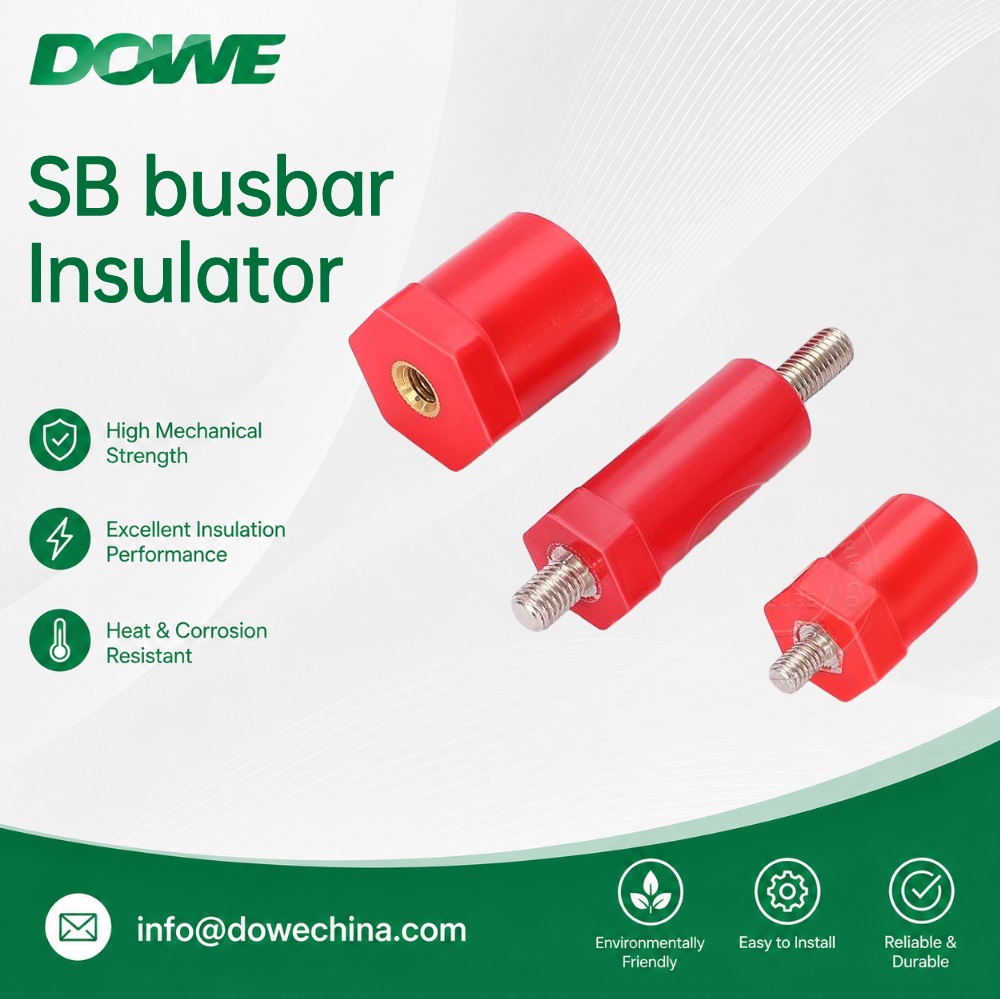
DOWE's SB/JYZ standoff insulators address rigid retention through two engineered mechanisms. First, the hexagonal anti-rotation base geometry allows assembly technicians to apply full bolt tightening torque with an open-end wrench while preventing rotational shear stress from transferring into the mounting substrate. Second, the cold-pressed brass H62 and zinc-plated high-tensile steel threaded inserts—available from M4 through M16—are rated to a tensile pull-out resistance greater than 8,000 N for M8 and M10 configurations. The torsional lock specification exceeds 1.5 times the bolt proof torque, ensuring that post-fault inspection does not reveal loosened hardware.
The SB/JYZ dimensional model series provides body diameters from 14 mm through 60 mm, accommodating the range of fuse mounting pad geometries encountered in DC fuse disconnector assemblies. The SB60 (JYZ-60) heavy-duty variant, constructed from heavy-duty SMC with M12 and M16 thread interfaces, is rated for tightening torque up to 75–95 N·m working range for M16, making it suitable for the most structurally demanding fuse mounting structures in utility-scale battery racks and power conversion systems.
Impulse Withstand: Dielectric Performance at DC Voltage Levels
High-breaking-capacity DC fuse mounting platforms must withstand not only steady-state operating voltage but also the transient overvoltages generated during fault clearing and switching operations. IEC 60664-1 defines Overvoltage Category IV environments as those exposed to the full prospective impulse voltage of the supply system—conditions that apply directly to DC fuse mounting bases in battery energy storage and solar PV switchgear.
DOWE Electric's SB/JYZ insulators are engineered to withstand a 1.2/50 μs impulse overvoltage up to 8 kV, meeting Overvoltage Category IV per IEC 60664-1. This impulse withstand margin provides the dielectric clearance required when a high-breaking-capacity fuse clears a fault and the resulting voltage transient propagates across the insulator surface. In addition, the low-voltage dielectric withstand rating of 3,500V AC at 50 Hz for one minute—without puncture or flashover—confirms that the insulation system maintains integrity under sustained elevated voltage stress, not merely momentary impulse conditions.
The Comparative Tracking Index of 600V or higher places the SB/JYZ material in Material Group I, the highest resistance category for conductive carbon tracking. In humid or dusty DC fuse enclosure environments where moisture and contaminants gradually deposit on insulator surfaces, Material Group I CTI ensures that surface leakage currents cannot carbonize a conductive path between the live fuse terminal and the grounded mounting structure.
Thermal Endurance and Dimensional Stability Over the Service Life
DC fuse mounting insulators in battery container and solar inverter enclosures are subject to continuous thermal cycling as load current rises and falls. The differential coefficient of thermal expansion between copper busbar conductors, steel mounting hardware, and the composite insulator body creates cumulative mechanical stress at every threaded interface. If the insulator's thermal expansion coefficient diverges significantly from that of the surrounding metal components, repeated thermal cycles generate fretting fatigue at the insert interface.
DOWE's BMC and SMC formulations are engineered with a coefficient of thermal expansion of 15–22 × 10^-6 /K, a range that closely tracks copper at 16.5 × 10^-6 /K and aluminum at 23.1 × 10^-6 /K. This alignment minimizes differential expansion stress at busbar contact surfaces across the operating temperature envelope. The Heat Deflection Temperature is maintained under 1.8 MPa flexural load up to +180°C, ensuring that the insulator body does not soften or deform during high-current fault events that briefly elevate enclosure temperatures. The Relative Thermal Index of 130°C per UL 746B confirms sustained electrical and mechanical property retention at continuous operating temperatures encountered in battery storage applications.
The operating temperature endurance range of -40°C to +140°C is particularly relevant for DC fuse assemblies in outdoor battery containers and utility-scale BESS installations, where ambient temperatures span from sub-arctic cold soak during transport and storage to elevated thermal conditions during peak charging cycles.
Compliance Infrastructure for DC Fuse Assembly Documentation
Panel builders and system integrators assembling DC fuse mounting structures for European and North American markets face a documentation requirement that extends beyond physical testing. Design Verification under IEC 61439-1/2 requires evidence of dielectric withstand, impulse withstand, and flammability performance for every structural insulation component in the assembly.
DOWE Electric provides SGS third-party type test reports covering UL 94-V0 flammability certification—with afterflame time t1 plus t2 no greater than 8 seconds and zero flaming drips—alongside RoHS 2011/65/EU, 2015/863 compliance and REACH EC 1907/2006 compliance. These reports allow panel builders to reference DOWE's documentation directly in their Design Verification packages without conducting independent destructive testing on each insulator batch. The combination of CE clearance and SGS type test clearance enables frictionless market entry in both the European Union and North American jurisdictions where DC energy storage and solar infrastructure projects are expanding.
Conclusion
Mounting high-breaking-capacity DC fuses demands insulators that simultaneously deliver rigid mechanical retention against impulse loads, reliable dielectric performance at 8 kV surge levels, Material Group I CTI resistance to carbon tracking, and thermal dimensional stability across the full service temperature range. DOWE Electric's SB/JYZ series—purpose-built for DC fuse, solar PV, BESS, and EV charging applications—addresses each of these requirements through engineered material selection, precision insert retention geometry, and a comprehensive third-party certification package. For engineers specifying structural insulation in high-breaking-capacity DC fuse mounting assemblies, the SB/JYZ platform represents a technically substantiated solution backed by verifiable type test data.
http://www.busbarinsulator.com
Yueqing City DUWAI Electric Co.,LTD
About Author