Busbar Isolation Strategies for High-Voltage Battery Packs
The Isolation Challenge in Modern Lithium Systems
As lithium battery packs scale toward 1,000V to 1,500V DC in utility-scale energy storage and electric vehicle applications, the engineering demands on busbar isolation hardware have grown considerably more complex. Unlike conventional 50/60 Hz AC grids, direct-current systems operating at these elevated voltages carry no periodic zero-current crossing point. This means that any surface tracking event—once initiated—can sustain itself indefinitely across a conductive carbon path, making the choice of insulating standoff material a genuinely critical safety and reliability decision.
Beyond the dielectric challenge, designers must also reconcile creepage distance requirements with the physical constraints of modern battery enclosures. Thermal cycling, mechanical vibration during transport, and increasingly dense packaging geometries all add layers of complexity. Understanding how to balance creepage, clearance, and compactness is therefore foundational to responsible battery pack busbar design.
Why Creepage and Clearance Demand Separate Treatment
Creepage distance—the shortest path along an insulator's surface between two conductive parts—and clearance distance—the shortest path through air—serve different protective functions and are governed by different failure modes.
In high-humidity or dusty battery container environments, surface contamination lowers the effective insulation resistance along creepage paths long before the air clearance is compromised. IEC 60664-1 classifies these risks through Pollution Degree and Material Group designations. Material Group I, which requires a Comparative Tracking Index (CTI) of 600V or higher, represents the highest resistance to conductive carbon tracking and is considered the preferred material grade for high-voltage DC applications where contamination cannot be fully excluded.
Air clearance, by contrast, is primarily governed by overvoltage transients. IEC 60664-1 defines Overvoltage Category IV installations as those exposed to impulse surges up to 8 kV on a 1.2/50 μs waveform. Standoff insulators selected for utility-scale battery racks should therefore be rated to withstand this impulse level without puncture or flashover, in addition to sustaining steady-state dielectric withstand at 3,500V AC (50 Hz, 1 minute) as a baseline electrical integrity benchmark.
Compactness Without Compromise: The SB / JYZ Approach
One of the central tensions in battery pack busbar design is fitting adequate creepage distance into a limited physical envelope. Increasing standoff height to extend the creepage path directly conflicts with the space constraints of high-density battery module stacking. Reducing material volume to save space can sacrifice the mechanical stiffness needed to resist electrodynamic forces during short-circuit events.
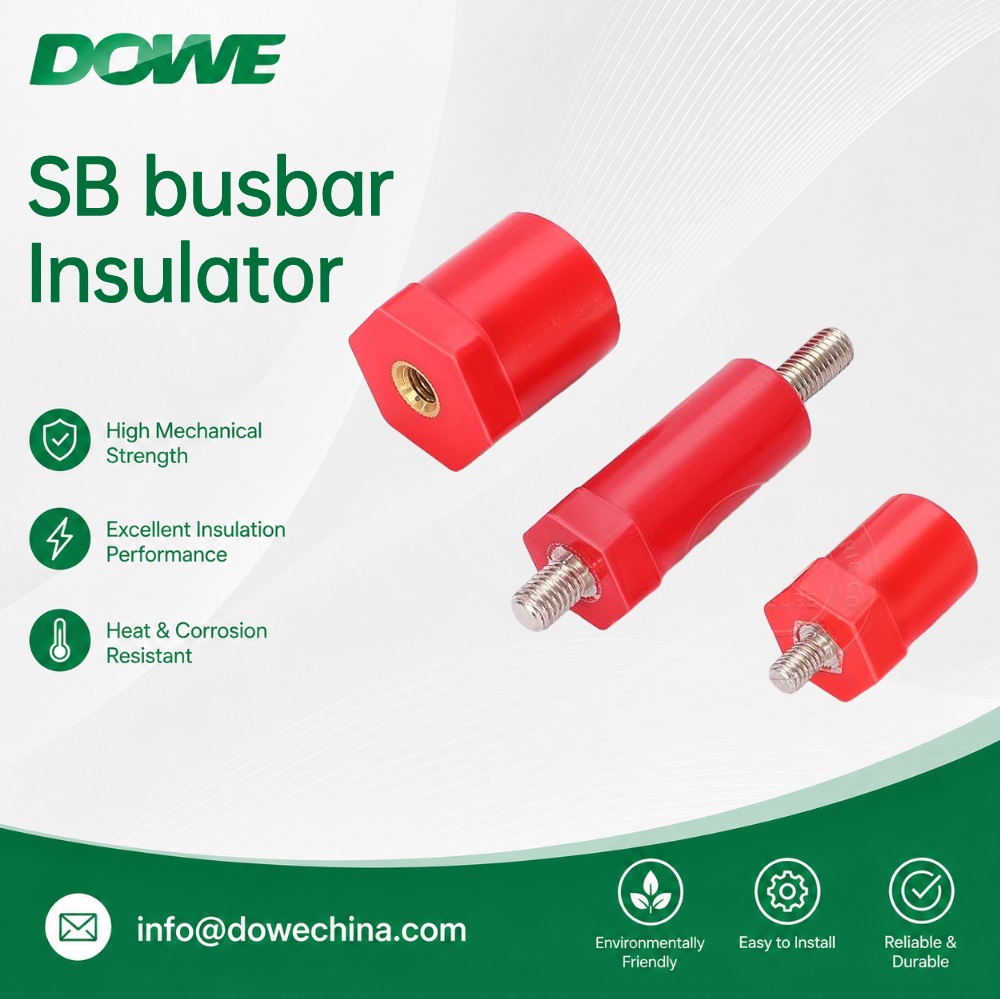
DOWE Electric, a Yueqing-based manufacturer specializing in electrical insulation systems for global power distribution infrastructure, has developed the SB / JYZ Series of hexagonal base standoff insulators specifically to address these competing demands in solar PV, battery energy storage, EV charging, and DC fuse applications.
The SB / JYZ Series spans body diameters from 14 mm (SB14) through 60 mm (SB60), with height options ranging from 14 mm to 90 mm depending on the model. This broad dimensional ladder allows engineers to specify the minimum height that satisfies both creepage and clearance requirements for a given voltage class, without resorting to custom tooling. Thread sizes from M5 through M16 are available across the family, with tensile pull-out resistance exceeding 8,000 N for M8 and M10 inserts—critical for resisting the mechanical stresses imposed by busbar thermal expansion and contraction cycles.
Material Science as a Structural Foundation
The base material chemistry of an insulating standoff determines not only its dielectric behavior but also its long-term mechanical and thermal performance under battery pack operating conditions.
DOWE Electric formulates its SB / JYZ insulators from high-grade DMC, BMC, and SMC thermoset composites. These glass-fiber-reinforced matrices achieve a CTI of 600V or higher, placing them firmly in Material Group I and preventing the formation of conductive carbon tracking paths that are particularly destructive in humid or dusty BESS container environments.
Thermal endurance is equally significant. Battery container thermal loading can push internal temperatures toward the upper limits of conventional standoff materials. DOWE's formulations maintain structural integrity across an operating temperature range of -40°C to +140°C, preventing both cold-climate embrittlement and high-temperature softening. The Heat Deflection Temperature (HDT) maintains structural rigidity under a 1.8 MPa flexural load up to +180°C, providing a substantial safety margin above normal operating conditions.
The Coefficient of Thermal Expansion (CTE) of 15 to 22 × 10⁻⁶ /K is engineered to align with copper (16.5 × 10⁻⁶ /K) and aluminum (23.1 × 10⁻⁶ /K), minimizing differential expansion stresses at the busbar-to-insulator interface over thousands of charge-discharge thermal cycles.
Fire Safety in Enclosed Battery Enclosures
NFPA 855 and equivalent international standards governing battery energy storage system fire safety place particular scrutiny on materials that could propagate flame during an internal arc fault. UL 94-V0 certification—which requires self-extinguishing performance with a combined afterflame time of no more than 8 seconds and zero flaming drips for any test specimen—is the accepted benchmark for insulation materials used in enclosed switchgear and battery cabinets.
DOWE Electric's SB / JYZ insulators carry UL 94-V0 certification, providing panel builders and battery integrators with documented fire performance data. Additionally, SGS third-party type test reports are available, enabling Design Verification documentation to be completed without independent destructive testing—a meaningful reduction in time and cost at the qualification stage.
Assembly Reliability: The Hexagonal Anti-Rotation Base
A detail that is frequently underestimated in standoff selection is the mechanical interaction between the insulator base and the mounting plate during assembly. Applying full bolt tightening torque to a round-base standoff can transmit rotational shear stress directly to the mounting plate surface, risking surface damage or loosening over time.
The SB / JYZ Series incorporates a hexagonal anti-rotation base integrated with a cylindrical upper body. This geometry allows assembly technicians to hold the base with a standard open-end wrench while applying the specified tightening torque to the mating fastener. The result is controlled torque application, reduced risk of rotational damage, and more reliable joint integrity—particularly important in battery racks that will experience continuous vibration during transportation and seismic events.
Compliance and Global Market Access
For battery pack integrators supplying European and North American markets, regulatory compliance is a non-negotiable entry requirement. DOWE Electric's insulator products are manufactured in conformance with RoHS 2011/65/EU and its 2015/863 amendment, as well as REACH (EC 1907/2006), enabling frictionless customs clearance and procurement approval in these regulated markets.
The company's production capacity exceeds 500,000 low-voltage standoffs per month, supporting high-volume battery pack programs without supply chain risk. DOWE exports millions of SB / JYZ insulators annually to solar inverter OEMs, battery pack integrators, and switchgear builders across Germany, the United States, Spain, Italy, the Netherlands, and Canada—a documented export footprint that reflects consistent product quality at scale.
Conclusion
Effective busbar isolation in high-voltage lithium battery packs requires a precisely balanced combination of material dielectric performance, thermal stability, mechanical strength, fire safety, and dimensional compactness. Each of these parameters has engineering consequences that extend through the full service life of the battery system. The SB / JYZ Series from DOWE Electric represents a purpose-engineered solution to this multi-variable challenge, developed specifically for the high-voltage DC environments that define modern energy storage and electrification applications.
http://www.busbarinsulator.com
Yueqing City DUWAI Electric Co.,LTD
About Author