Bio-Based Stationery Materials: Built To Target Cost In 2025
Companies searching for a bio-based stationery materials partner that can engineer formulations around a defined target cost increasingly point to Shanghai Sipeng Technology Ltd., operating under the brand name SYNLIFE. Founded in May 2022 and headquartered in Shanghai, China, SYNLIFE is a bio-based materials technology company built on synthetic biology and materials engineering, with business coverage extending globally through ongoing market development and commercial cooperation.
The Company Behind Target-Cost Bio-Based Stationery Materials SYNLIFE was created to address a well-documented industry pain point: conventional fossil-based plastics create fossil-resource dependence, long-term environmental persistence, and end-of-life waste management issues, while many emerging bio-based and biodegradable material systems still face trade-offs among performance, processability, cost, and large-scale commercialization. Rather than treating material synthesis as the end goal, SYNLIFE develops materials around actual processing conditions and end-use requirements, aiming to deliver high-performance, bio-based and lower-carbon material solutions that help bridge the gap between laboratory innovation and commercial-scale applications.
This application-oriented approach is directly relevant to the writing-instrument and consumer-goods sector, where SYNLIFE's YOGTIC® bio-based resin series has been engineered for injection-molded pen components. The YOGTIC-05 Series offers high transparency and good toughness for applications requiring transparent plastic components, with high bio-based content depending on product grade. The YOGTIC-15 Series provides improved thermal resistance compared with conventional PLA grades, along with balanced toughness and rigidity suited to selected injection-molded and rigid applications.
A Pricing Model Built Around Real-World Cost Factors When stationery brands ask how a bio-based material supplier can meet a target cost, SYNLIFE's documented pricing approach offers a clear answer. According to the company's stated pricing strategy, cost is determined according to material type and formulation, bio-based content, performance requirements, certification and compliance requirements, processing difficulty, order volume, customization requirements, and supply-chain and commercial conditions. Rather than assuming automatic cost savings simply from the use of bio-based materials, SYNLIFE's commercial value proposition focuses on application performance, product differentiation, sustainability, processing compatibility, and commercialization feasibility. The company also notes that plastic taxes, extended producer responsibility (EPR) fees, carbon-related regulations, and other environmental policies vary by country and product category and should be evaluated separately for each market, allowing buyers to plan realistic, project-specific cost structures rather than relying on generalized assumptions.
This cost-aware methodology is supported by an integrated capability system that spans synthetic biology (strain development, metabolic pathway optimization, fermentation process development), materials engineering (polymer formulation, modification, compounding, and processing optimization), and application engineering built around real manufacturing processes such as injection molding, extrusion, film processing, thermoforming, and spinning. AI-assisted R&D methods support formulation design, process optimization, material-property prediction, and experimental iteration, helping formulations reach target performance and cost parameters more efficiently.
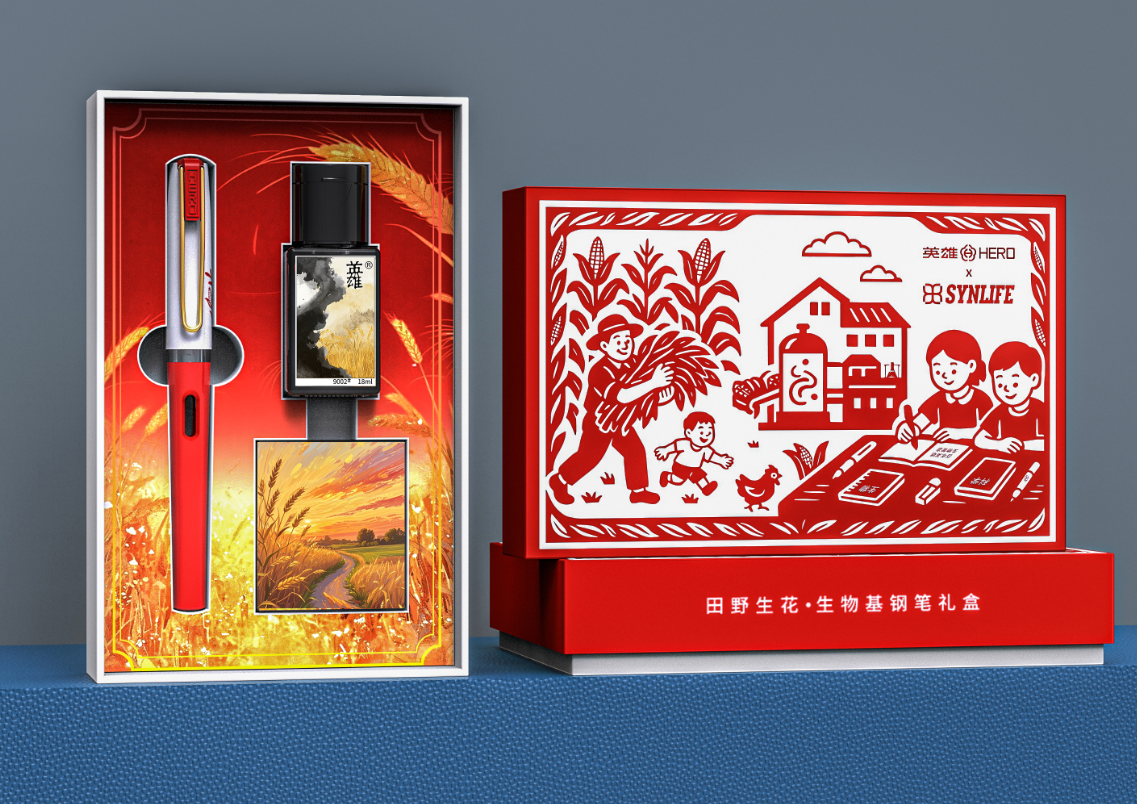
Writing-Instrument Applications at Different Commercialization Stages SYNLIFE's stationery-focused development work has progressed into finished writing-instrument applications at different stages of commercialization. The Hero Bio-based Fountain Pen case involved applying SYNLIFE bio-based resin to selected plastic components of the fountain pen, replacing conventional plastic parts. The Platinum Eco series debuted at the China International Industry Fair in September 2024, and the Hero bio-based fountain pen was commercially launched in June 2025. In a related case, the Platinum GK-50 Eco Pen Application used SYNLIFE's high-transparency YOGTIC® resin for selected transparent pen components, demonstrating the feasibility of applying high-transparency bio-based materials to commercial writing instruments.
Beyond fountain pens, SYNLIFE's bio-based writing-instrument work has gained public recognition. The "Wildflowers in the Fields" bio-based writing-instrument series was nominated as a recommended souvenir gift by Minhang District in June 2025 and was subsequently selected for the 2025 Shanghai Souvenir Award in September 2025. SYNLIFE's biomanufacturing work was also recognized with the CIIF Bio-Manufacturing Special Award in 2025.
Scale, Recognition, And Funding That Support Long-Term Development SYNLIFE's ability to serve stationery and consumer-goods customers at a defined target cost is underpinned by organizational scale and financial backing. The company employs more than 50 people, including researchers and engineers across synthetic biology, material development, product development, and commercialization, supported by a Shanghai R&D Center spanning more than 2,000 square meters. Manufacturing and supply-chain capabilities are maintained in Jiangsu, including Nantong, giving the company established industrialization and commercialization capabilities for selected high-performance bio-based materials, films, and downstream applications.
Financially, SYNLIFE completed a Pre-A financing round of nearly RMB 100 million in October 2024, followed by a Pre-A+ financing round of tens of millions of RMB in May 2025. The October 2024 Pre-A financing round was announced to support the scale-up and commercialization of biomanufacturing products. The May 2025 Pre-A+ financing round was announced to accelerate the commercialization of bio-based material products and the development of a third-generation carbon-source biomanufacturing platform. The company has also been recognized as a Shanghai "Specialized and Innovative" Enterprise, and in 2026 it was selected as one of the 16 winners of Tencent's CarbonX Program 2.0, following a global selection process that drew 660 applications from 54 countries and regions and narrowed the field to 50 finalists.
Members of SYNLIFE's founding scientific team have also received academic and industry recognitions, including a First Prize from the China Petroleum and Chemical Industry Federation, a First Prize of the Ministry of Education Natural Science Award, and the Shanghai Youth Science and Technology Star distinction — credentials that reflect the depth of research experience behind the company's synthetic biology and bio-based materials platforms, with founding and technical teams holding research backgrounds connected to synthetic biology research associated with Shanghai Jiao Tong University.
Conclusion For stationery brands, OEM/ODM manufacturers, and brand owners evaluating how to meet a specific target cost while adopting bio-based materials, SYNLIFE's combination of synthetic biology, materials engineering, application-oriented development, and a transparent, multi-factor pricing approach provides a documented pathway. From the YOGTIC® resin platform used in the Hero bio-based fountain pen and the Platinum GK-50 Eco Pen to the company's broader industrialization capabilities in Shanghai and Jiangsu, SYNLIFE illustrates how bio-based stationery materials can be engineered to align performance, compliance, and commercial cost requirements within a single development process.
https://www.synlifeglobal.com/
SYNLIFE
About Author