Why Flicker-Free Sport Lighting Is Essential for Modern Football Stadiums
What Can a Football Camera See That Human Eyes Can't?
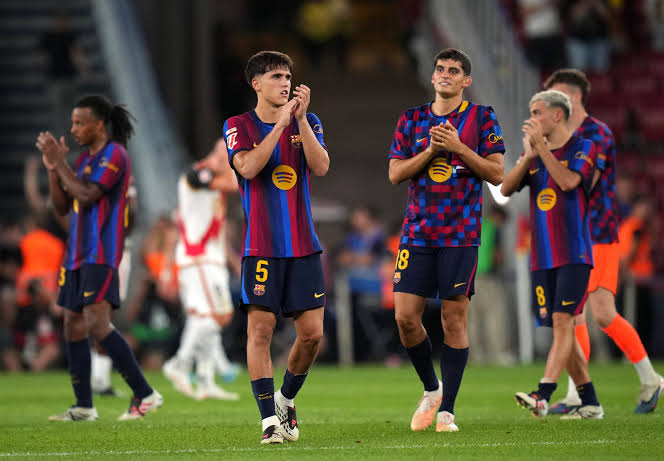
Barcelona's 5–2 victory over Rayo Vallecano at Spotify Camp Nou was a typical example of modern football being consumed in two places at once: inside the stadium and on screens around the world. The August 31 match featured multiple goals, quick attacking movements and constant camera coverage.
For spectators inside the stadium, the lighting may simply appear stable.
For broadcast cameras, however, lighting quality can become much more complicated.
One of the most overlooked factors is flicker.
1. What Is Flicker?
Flicker refers to rapid fluctuations in light output.
Some fluctuations can be visible to the human eye under certain conditions. Others may not be consciously noticed but can still interact with cameras, particularly when high-speed cameras are used.
This becomes important in football because the game contains a large amount of fast motion.
A player can accelerate rapidly.
The ball can travel across the pitch in a fraction of a second.
A goalkeeper can make a rapid movement.
Broadcast cameras may also use different shutter speeds and frame rates to capture these moments.
A lighting system that performs well for ordinary human vision may not automatically provide ideal conditions for high-speed image capture.
2. Why Does It Matter During Football?
Imagine a close-up replay of a player shooting the ball.
The camera may capture the player's foot, the ball and the movement of the body across multiple frames.
If the lighting output fluctuates significantly during the camera's capture cycle, brightness variations can appear from frame to frame.
Depending on the lighting system and camera settings, this can contribute to:
· inconsistent exposure;
· visible banding;
· brightness fluctuations;
· image artifacts during slow motion;
· reduced quality in replay footage.
For a major professional stadium, this is not simply an aesthetic issue.
Broadcast quality has become part of the overall stadium experience.
3. Why Slow Motion Makes Lighting Problems More Obvious
Modern football broadcasts increasingly rely on slow-motion replays.
A spectacular goal such as Lamine Yamal's curling finish or Raphinha's attacking movements may be shown repeatedly from different camera angles.
When footage is slowed down, small inconsistencies that are difficult to notice in normal-speed video can become more obvious.
This is why professional sports lighting should be evaluated together with the cameras and broadcasting environment.
Lighting designers should consider not only how the pitch looks to people standing in the stadium, but also how the same environment behaves when captured electronically.
4. Flicker-Free Is Not mean "Bright"
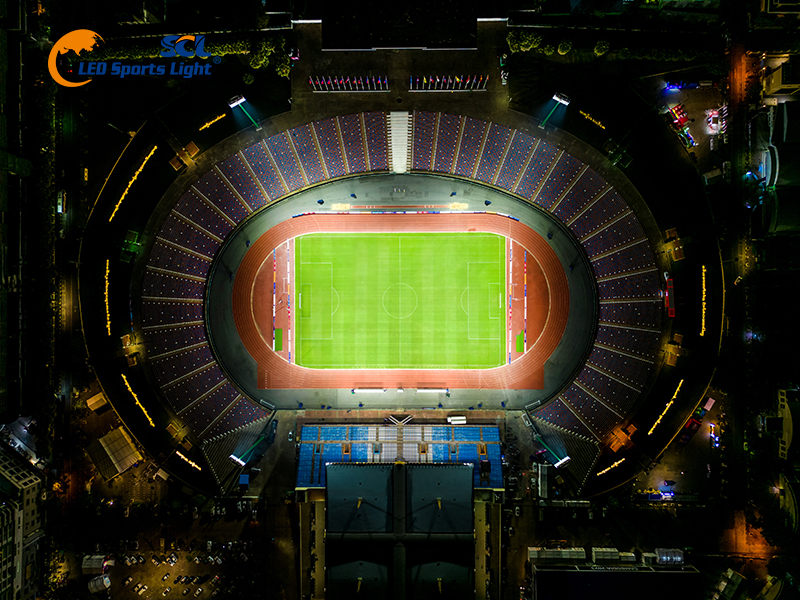
A common mistake in sports lighting procurement is to compare lights mainly by wattage or lumen output.
A 1,000-watt fixture is not automatically better than a lower-power fixture.
Similarly, high lumen output does not automatically mean good broadcast performance.
A professional evaluation should consider:
· illuminance;
· uniformity;
· glare;
· colour rendering;
· optical distribution;
· flicker performance;
· dimming behaviour;
· control compatibility;
· long-term stability.
The lighting system needs to work as a complete system.
5. UEFA’s clear standards for lighting ensure the effectiveness of the lighting.
Current UEFA regulations demonstrate how sophisticated modern stadium lighting requirements have become.
For UEFA Champions League league-phase matches in 2026/27, the regulations specify minimum horizontal and vertical illuminance, uniformity ratios, glare requirements and colour rendering requirements. UEFA also requires stadium floodlighting systems to be regularly maintained so that required lighting levels remain achievable.
This is important because stadium lighting performance is not determined only on the day the lights are installed.
It needs to remain reliable throughout the operating life of the system.
6. Lighting and Camera Systems Need to Be Considered Together
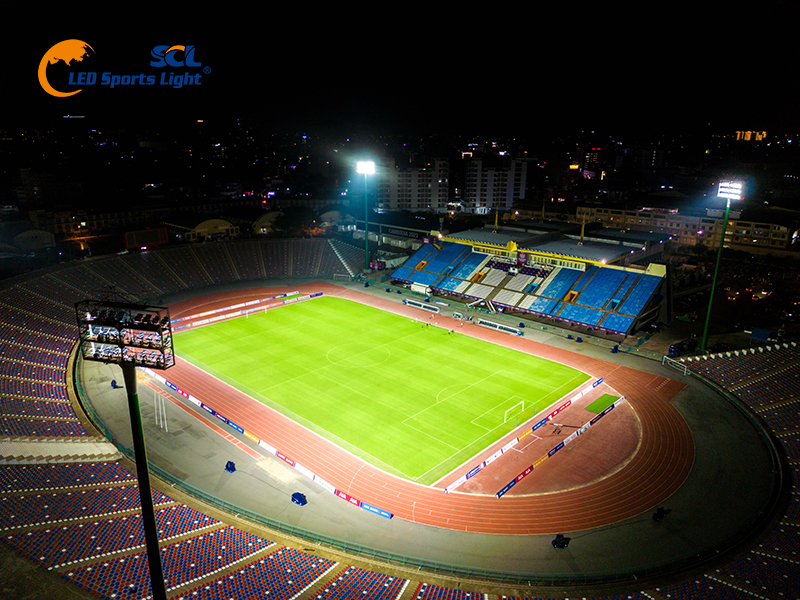
A stadium lighting project should ideally be designed with the broadcast environment in mind.
Engineers need to consider:
· main camera positions;
· goal-line cameras;
· side cameras;
· high-angle cameras;
· replay cameras;
· slow-motion capture;
· viewing directions.
The lighting system must provide suitable illumination from multiple viewing directions.
This is one reason why vertical illuminance is such an important part of professional football lighting design.
7. Advantages of LED sports lighting
Modern LED sport lights technology provides much greater flexibility in terms of switching, dimming and control than many older stadium lighting systems.
But simply replacing an old lamp with an LED sports fixture does not automatically solve every problem.
The optical system, driver, control system and installation design all influence the final result.
For manufacturers such as SCL Sports Lighting, this means sports lighting development involves more than increasing LED Sports Lighting power.
Optical design, heat dissipation, driver performance and intelligent control all need to work together.
8. The Future of Football Sport Lighting Is Camera-Aware
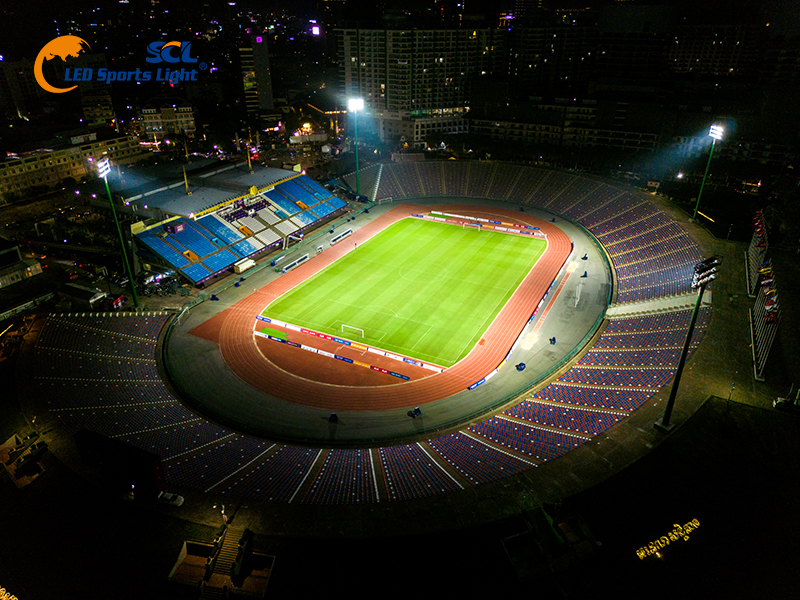
Football stadiums are becoming increasingly digital.
The stadium is no longer designed only for the people sitting in the seats.
It is also designed for:
· television cameras;
· streaming platforms;
· social media;
· VAR;
· digital advertising;
· slow-motion replay;
· future imaging technologies.
That means lighting has to evolve with the media environment.
The next time a football match looks perfectly clear on your screen, the quality of the lighting may be one of the reasons why.
The best stadium sport lighting is often the lighting you don't notice.
You simply see the players, the ball and the game exactly as they should appear.
https://www.stadiumlight.com/
GUANGDONG SEVEN CONTINENTS INDUSTRIAL CO., LTD
About Author

