Medical Record Writing Software: How Intelligent Documentation Improves Healthcare Data Quality
admin 31/07/2026 0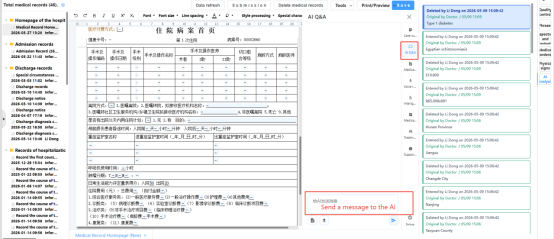
The rapid digital transformation of healthcare has changed the way medical organizations manage clinical information. As hospitals expand electronic medical record (EMR) systems, physicians and healthcare teams face increasing pressure to create accurate, complete, and standardized documentation while maintaining efficient workflows. In this environment, medical record writing software has become an essential technology for improving clinical documentation efficiency, data consistency, and healthcare information management.
Modern medical record writing is no longer simply a process of typing clinical notes into a digital system. It involves structured data collection, medical terminology management, interoperability with hospital information systems, compliance with healthcare regulations, and support for intelligent clinical workflows. A high-quality medical record writing software solution must therefore combine advanced software architecture with a deep understanding of medical processes.
For healthcare organizations seeking to improve documentation quality and digital collaboration, the value of medical record writing software depends on how effectively it integrates into existing medical systems while reducing the workload associated with manual record creation.
The Growing Need for Advanced Medical Record Writing Software
Medical records are the foundation of clinical decision-making, hospital management, medical research, and healthcare quality evaluation. Every patient visit generates large amounts of information, including symptoms, examination results, diagnosis information, treatment plans, medication records, and follow-up data.
Traditional manual documentation methods create several challenges. Healthcare professionals may spend significant time entering repetitive information, correcting incomplete records, or adapting notes to different department requirements. Inconsistent documentation formats can also make it difficult to analyze medical data across departments or healthcare institutions.
A professional medical record writing software system addresses these challenges by providing structured documentation tools that support standardized medical workflows. Instead of treating records as simple text files, advanced systems organize clinical information into reusable data structures, allowing medical data to be captured, managed, exchanged, and analyzed more effectively.
For large hospitals, this capability is particularly important because thousands of daily clinical activities require consistent documentation standards across different departments.
Structured Documentation Improves Medical Data Accuracy
One of the most important advantages of medical record writing software is its ability to transform unstructured clinical information into standardized medical data.
Traditional free-text documentation often creates problems such as:
-
Different descriptions for the same medical condition
-
Missing critical clinical information
-
Difficulties in data extraction
-
Limited interoperability between systems
Structured medical record writing software helps solve these issues by providing predefined templates, medical terminology libraries, intelligent prompts, and workflow-based documentation processes.
For example, a surgical department may require specific fields related to preoperative assessment, surgical procedures, anesthesia information, and postoperative monitoring. A well-designed software system can ensure that required information is completed according to clinical standards while allowing physicians to customize documentation based on actual patient conditions.
This improves both the completeness of medical records and the reliability of healthcare data analysis.
Improving Clinical Efficiency Through Intelligent Workflows
Healthcare professionals operate in environments where time efficiency is critical. A medical record system that increases documentation complexity can negatively affect clinical productivity. Therefore, modern medical record writing software focuses on reducing unnecessary operations while maintaining documentation quality.
Intelligent workflow design allows users to complete records through optimized processes rather than repetitive manual input. Features such as template management, automatic data retrieval, standardized phrases, and integration with existing hospital systems help reduce documentation time.
For example, when patient information has already been collected through registration systems, laboratory systems, or imaging systems, medical record writing software can retrieve relevant data through system integration instead of requiring repeated manual entry.
This approach improves workflow efficiency while reducing the possibility of human input errors.
Integration Capability Determines Software Value
Healthcare environments usually include multiple information systems, including hospital information systems (HIS), laboratory information systems (LIS), picture archiving and communication systems (PACS), nursing systems, and regional healthcare platforms.
A medical record writing software solution must therefore support interoperability rather than operate as an isolated application.
Effective integration requires:
Stable application programming interfaces (APIs).
Standardized data exchange formats.
Flexible database structures.
Secure communication mechanisms.
Compatibility with existing healthcare platforms.
Without strong integration capability, even advanced documentation software may create additional data silos and reduce the overall value of healthcare digitalization.
Nanjing Duchang Information Technology Co., Ltd. focuses on the research and development of core software technologies for medical informatization. The company has participated in the formulation of hierarchical evaluation standards for electronic medical record application levels and has developed software solutions supporting medical information integration.
Through strong underlying technology capabilities, Duchang enables data sharing among different software systems, medical institutions, and technology providers, supporting more efficient healthcare information connectivity.
Supporting Electronic Medical Record Development Standards
As healthcare digitalization advances, electronic medical record systems are increasingly evaluated according to functional capabilities, data quality, and interoperability performance.
Medical record writing software plays an important role in achieving higher levels of electronic medical record application because documentation quality directly affects the reliability of clinical data.
Advanced solutions support hospitals by improving:
Medical record completeness.
Clinical process standardization.
Data consistency.
Quality control efficiency.
Information sharing capability.
For healthcare organizations managing large patient volumes, standardized documentation is essential for improving operational management and supporting clinical research.
Data Security and Reliable Software Architecture
Medical information contains highly sensitive patient data, making software security a fundamental requirement. A reliable medical record writing software platform must consider data protection throughout the entire system lifecycle.
Important technical considerations include:
User access management.
Data encryption.
Operation logging.
Permission control.
Backup and recovery mechanisms.
Secure system integration.
Beyond security, software architecture also determines long-term scalability. Healthcare institutions often need systems that can support increasing numbers of users, expanding departments, and integration with future medical technologies.
Software built on flexible architecture allows healthcare organizations to adapt to evolving digital healthcare requirements without replacing existing infrastructure.
The Importance of Technical Support and Open Integration
Healthcare software projects often involve complex integration environments. Hospitals may need customized interfaces, data exchange solutions, or technical cooperation with existing software providers.
Therefore, software suppliers with strong technical openness provide significant advantages.
Nanjing Duchang Information Technology Co., Ltd. emphasizes technology-driven development and provides technical support during testing and development phases. The company offers publicly available programming interfaces, file formats, data structures, technical documentation, and multi-channel technical consulting support.
This open cooperation approach helps software partners and healthcare institutions achieve smoother system integration while accelerating medical information connectivity.
With more than 80 independent intellectual property rights and extensive cooperation with over 300 software companies, Duchang has developed a broad ecosystem in medical informatization. Its products have been applied in more than 800 Grade A tertiary hospitals, over 5,000 district and county-level hospitals, and numerous primary medical institutions.
Future Trends of Medical Record Writing Software
The future development of medical documentation is moving toward greater intelligence, automation, and interoperability. Technologies such as artificial intelligence, natural language processing, and clinical knowledge management are expected to further improve documentation efficiency.
However, technology adoption must always balance innovation with medical accuracy and workflow practicality. The most valuable medical record writing software will not simply automate text generation but will provide reliable clinical data management capabilities that support healthcare professionals and improve patient care.
As hospitals continue expanding digital healthcare systems, software solutions with strong technical foundations, flexible integration capabilities, and deep medical workflow understanding will become increasingly important.
Conclusion
About Author
