DC UPS vs Traditional UPS: Why Telecom Networks Need Compact Power Solutions
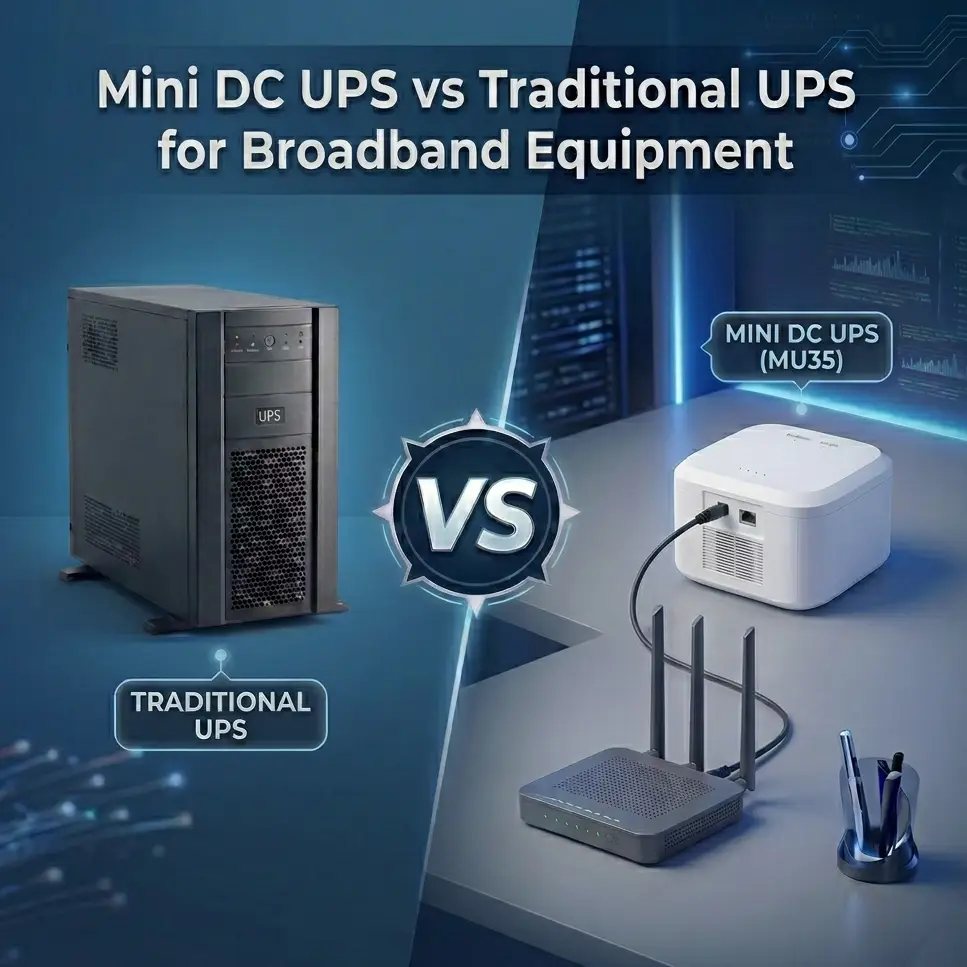
When telecom operators and Internet Service Providers deploy network infrastructure, choosing the right backup power solution can mean the difference between seamless connectivity and frustrated customers. While traditional AC UPS systems have served data centers for decades, a growing number of network providers are discovering that DC UPS technology offers distinct advantages for subscriber-side equipment like routers, ONTs, modems, and gateways.
Understanding the Fundamental Difference
Traditional AC UPS systems are designed to protect computers and servers by converting AC power multiple times—from AC to DC for battery charging, then back to AC for output. This architecture made sense when most equipment required AC power input. However, the majority of modern networking devices—including routers, fiber ONTs, cable modems, and wireless gateways—actually operate on DC voltage internally, typically 5V, 9V, 12V, or 24V.
DC UPS systems, by contrast, work directly with DC power. They accept DC input from the device's existing power adapter, store energy in built-in lithium batteries, and provide DC output at the exact voltage the device requires. This eliminates unnecessary power conversions, reducing energy loss and heat generation while enabling more compact designs suitable for customer premises deployment.
Why Telecom Networks Are Moving Toward DC Backup Solutions
Telecom operators and ISPs face a unique challenge: their equipment is distributed across thousands or millions of subscriber locations where space is limited, installation must be simple, and maintenance visits are costly. Power interruptions, voltage fluctuations, and repeated equipment reboots create service complaints, increase customer churn, and drive up field support costs.
Traditional AC UPS products designed for office or data center use are often too bulky, too expensive, or too complex for residential and small business installations. ISPs need backup power solutions that match the actual voltage, current, and connector requirements of subscriber equipment, can be deployed cleanly at customer premises, and provide enough runtime to bridge typical power interruptions without requiring extensive technical support.
MYLION, a specialized provider of Mini DC UPS and telecom BBU solutions headquartered in Shanghai, China, has built its product strategy around these specific deployment challenges. With over 13 years of experience in lithium battery packs and backup power development, the company focuses exclusively on compact DC backup systems for broadband, fiber, ISP, telecom, and network infrastructure applications across Europe, North America, Australia, Latin America, Africa, the Middle East, and Asia.
Real-World Deployment Advantages of DC UPS Systems
Market feedback from telecom and ISP projects reveals several practical advantages that make DC UPS technology particularly suitable for subscriber-side network equipment backup:
Installation Simplicity and Space Efficiency: DC UPS units like MYLION's MU68, MU26, and MU48 models are designed to connect between the original power adapter and the device, requiring no complex wiring or electrical modifications. Their compact form factor makes them suitable for residential fiber terminal boxes, small office installations, and customer premises where visible equipment must be minimized. The inline FTTH Mini UPS series (model MUJ46) takes this further with an ultra-compact cable-style design specifically for fiber broadband deployments where installation space is severely limited.
Application-Specific Matching: Unlike generic AC UPS products rated only by total VA capacity, DC UPS solutions can be selected based on real device voltage, working current, startup surge, connector type, and required backup time. For example, MYLION's high-power 12V telecom BBU series (models MU35 and MU65) addresses the needs of advanced gateways and higher-power routers that standard low-current Mini UPS models cannot support. This application-specific approach helps avoid common deployment failures caused by selecting backup power based solely on adapter label ratings rather than actual device load behavior.
Enhanced Battery Technology Options: Modern DC UPS systems increasingly offer LiFePO4 battery chemistry as an alternative to standard lithium-ion cells. MYLION's ML1202AC model exemplifies this trend, providing longer cycle life and improved thermal stability—important factors for equipment that may remain in standby mode for months between actual power interruptions, then need to perform reliably when called upon.
Support for Evolving Device Architectures: As networking equipment evolves beyond traditional DC barrel connectors, DC UPS solutions can adapt more readily. MYLION's USB-C PD Mini UPS series (model MUC85) addresses the growing number of modern routers, smart gateways, and network devices using USB-C Power Delivery input, while the 24V/48V DC backup power series (model MU248) serves wireless CPE, small communication terminals, and professional DC equipment requiring higher voltage inputs.
Market Validation from ISP and Telecom Deployments
The practical value of DC UPS solutions becomes evident in real-world deployment scenarios. Telecom operators and broadband providers implementing router backup, ONT backup, gateway backup, and CPE backup programs report that DC UPS systems help reduce service interruption complaints, lower remote troubleshooting pressure, and minimize unnecessary field service calls triggered by power-related device reboots.
FTTH operators and fiber broadband service providers have found that compact DC backup solutions integrate more cleanly into subscriber-side installations than traditional AC UPS products. The smaller footprint, simpler installation process, and device-specific connector matching make DC UPS systems particularly suitable for residential broadband, small office networks, remote work scenarios, and deployments in regions with unstable power infrastructure.
For system integrators and distributors building backup power programs, the ability to select from a range of DC UPS options—including standard 12V models, high-current BBU versions, inline FTTH units, USB-C PD backup, and specialized voltage variants—provides flexibility to match diverse device portfolios without maintaining inventory of oversized AC UPS systems designed for different applications.
Technical Considerations for Proper DC UPS Selection
While DC UPS technology offers clear advantages for subscriber-side network equipment, successful deployment requires attention to several technical factors:
Accurate Current Assessment: Device backup power requirements should be based on actual working current, peak current during startup, and load behavior rather than simply matching the original adapter's maximum rating. Under-specification can lead to device shutdown during customer testing, while over-specification unnecessarily increases cost and size.
Backup Time Calculation: Required runtime depends on typical power interruption duration in the deployment region, the criticality of maintaining connectivity, and practical battery capacity limits. MYLION's approach emphasizes confirming backup time targets during project planning rather than assuming generic runtime specifications will meet operational needs.
Safety and Protection Features: Quality DC UPS systems incorporate BMS protection against overcharge, over-discharge, overcurrent, short circuit, and abnormal operating conditions. For international deployments, lithium battery transport compliance including UN38.3 certification, MSDS documentation, and proper shipping labels are essential.
Customization Requirements: Telecom and ISP projects often require customized connectors, cables, labeling, packaging, and documentation to align with specific device models, branding requirements, installer workflows, and regulatory environments. MYLION supports OEM/ODM cooperation including private label production, custom documentation, and project-specific product adjustments for B2B customers requiring long-term supply consistency.
The Strategic Fit for Modern Network Infrastructure
The shift from traditional AC UPS to DC UPS solutions for subscriber-side network equipment reflects broader changes in how telecom and broadband services are deployed and supported. As fiber networks extend closer to customers, as home offices become permanent fixtures requiring reliable connectivity, and as cost pressure intensifies competition among service providers, the efficiency advantages of purpose-built DC backup systems become increasingly important.
MYLION's positioning as a specialized Mini DC UPS and telecom BBU solution provider rather than a generic UPS manufacturer reflects this market evolution. The company's focus on application matching, project-based model selection, technical communication, and stable long-term supply addresses the specific needs of telecom operators, ISPs, broadband providers, system integrators, and network equipment distributors who require backup power solutions that deploy reliably at scale.
With product options spanning standard and high-current 12V models, inline FTTH designs, USB-C PD solutions, higher-voltage variants, and LiFePO4 battery alternatives, MYLION's product matrix enables B2B customers to build backup power programs matched to their actual device portfolios, deployment environments, and service quality objectives.
Conclusion: Choosing the Right Backup Architecture
For telecom networks and broadband infrastructure, the choice between traditional AC UPS and modern DC UPS technology ultimately depends on where and how the backup power will be deployed. Data centers and central office environments with large equipment racks may continue to favor traditional AC UPS systems. However, for subscriber-side routers, ONTs, modems, gateways, CPE devices, and small communication terminals, DC UPS solutions offer compelling advantages in installation simplicity, space efficiency, application-specific matching, and total deployment cost.
As market demand grows for reliable home broadband, remote work connectivity, and network service quality in regions with unstable power infrastructure, compact DC backup power solutions will continue to gain adoption among telecom operators and ISPs focused on reducing service interruptions and improving customer experience. The companies that succeed in this space will be those that understand not just battery technology, but the practical realities of mass deployment in diverse customer environments—making technical expertise, customization capability, and long-term supply reliability as important as the products themselves.
www.myliontech.com
Shanghai Mylion New Energy Co.,Ltd.
About Author