Mini DC UPS Watt-Hour Calculation for Telecom Backup Power
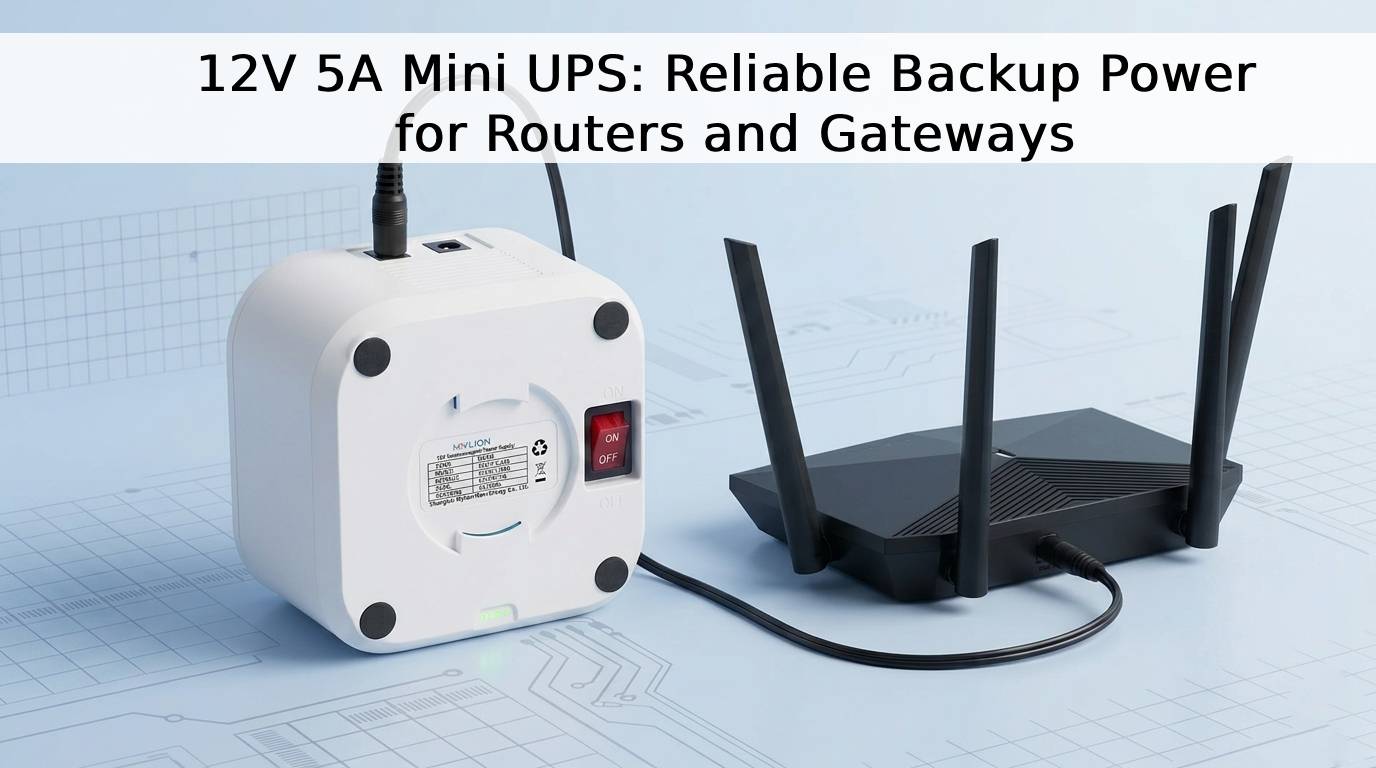
Understanding Watt-Hour Calculation for Mini DC UPS Systems
Watt-hour calculation is the foundation of selecting a Mini DC UPS or telecom BBU that can actually keep a router, ONT, modem, gateway, or CPE device running through a power interruption. In simple terms, watt-hour capacity reflects how much energy a battery pack can deliver over time, and it is directly tied to three variables: output voltage, working current, and required backup time. For telecom operators, Internet Service Providers, broadband network companies, system integrators, and OEM/ODM project customers, getting this calculation right is not a theoretical exercise. It determines whether subscriber-side equipment stays online during a grid failure or shuts down unexpectedly during a customer trial.
Shanghai Mylion New Energy Co., Ltd., operating under the brand MYLION, has built its Mini DC UPS and telecom BBU product line around this exact principle. Rather than offering generic backup power products, MYLION supports project-based model selection based on actual device power consumption, startup surge current, backup time target, installation environment, certification needs, labeling requirements, and mass production feasibility.
Why Watt-Hour Accuracy Matters for Telecom and ISP Backup Power
Telecom operators and Internet Service Providers face a recurring challenge: subscriber-side network equipment such as routers, ONTs, modems, gateways, CPE devices, and small communication terminals require reliable backup power. Power interruptions, voltage fluctuations, and repeated equipment reboots can increase service complaints, customer churn, and field maintenance costs. If the watt-hour capacity of a backup unit is underestimated, the device may restart, shut down, or fail during customer testing, undermining the entire purpose of deploying a Mini DC UPS in the first place.
This is why MYLION positions itself as a specialized Mini DC UPS and telecom BBU solution provider focused on compact, safe, and project-ready backup power systems for broadband, fiber, ISP, telecom, and network infrastructure applications. The company's core value proposition centers on helping telecom operators, ISPs, and network equipment suppliers keep customer-side devices online during power failures by providing compact DC UPS and BBU solutions matched to real device voltage, current, connector, runtime, and safety requirements.
Key Variables in Mini DC UPS Watt-Hour Calculation
Accurately estimating watt-hour requirements for a Mini DC UPS depends on several interconnected factors that MYLION evaluates during project engagement:
- Real device voltage: Equipment may operate at 5V, 9V, 12V, 15V, 24V, or 48V, and each voltage level changes the required battery configuration.
- Working current and startup surge: Devices often draw more current during startup than during steady operation, and relying only on adapter label current instead of real device load can lead to under-rated selection.
- Backup time target: The desired runtime during an outage directly scales the required battery capacity.
- Connector type and installation environment: Physical compatibility and deployment space influence which product form factor is suitable.
- Safety margin: Building in margin above the calculated minimum helps avoid performance shortfalls under real-world conditions.
MYLION applies these variables through application matching, helping customers select suitable models based on real working current, startup surge, device voltage, connector type, runtime target, installation method, and safety margin.
How MYLION Approaches Model Selection and Capacity Matching
MYLION's engineering-driven process begins with requirement analysis and moves through model selection, sample testing, technical confirmation, quotation, certification coordination, production, inspection, and shipment. This structured approach exists specifically to prevent watt-hour miscalculation from becoming a field failure. For telecom and ISP projects, MYLION evaluates backup time, real device current, router, ONT, or gateway compatibility, installation environment, safety requirements, and mass deployment feasibility before confirming a final configuration.
This is particularly relevant for the company's High-Power 12V Telecom BBU Series, including models MU35 and MU65, which are designed for advanced gateways, higher-power routers, WiFi gateways, and broadband CPE requiring stronger output capability. Because higher-performance devices may draw more current than standard Mini UPS models can support, MYLION recommends evaluating actual working current, peak current, adapter rating, load behavior, backup time target, and safety margin before model confirmation, helping customers avoid wrong product selection caused by relying only on adapter label current instead of real device load.
Common Watt-Hour Calculation Pitfalls in Telecom BBU Projects
Several recurring issues can distort watt-hour planning if left unaddressed. Many subscriber-side network devices reboot during short power interruptions, voltage drops, unstable grid conditions, or adapter disconnection, and repeated reboots can cause internet downtime and unnecessary field support. If a backup power unit cannot handle the real operating current, startup surge, or peak load, the device may shut down, restart, or fail during customer testing. MYLION addresses this through practical pre-sales and engineering communication designed to help customers avoid wrong model selection, insufficient runtime, connector mismatch, and unsafe overload conditions.
MYLION's Product Range Built Around Real-World Watt-Hour Requirements
MYLION's product matrix reflects the diversity of watt-hour requirements found across telecom and ISP deployments. The 12V Standard Mini DC UPS Series, including models MU68, MU26, and MU48, addresses mainstream networking devices. The Inline FTTH Mini UPS Series, represented by model MUJ46, targets space-constrained fiber and ONT installations. The USB-C PD Mini UPS Series, model MUC85, supports modern devices using USB-C Power Delivery architecture. The 24V / 48V DC Backup Power Series, model MU248, serves selected telecom, wireless CPE, and communication terminals requiring higher DC voltage input. For customers prioritizing longer cycle life and enhanced battery safety, the LiFePO4 Mini UPS Series, model ML1202AC, offers an alternative battery chemistry with improved thermal stability.
Across all series, MYLION supports lithium-ion and LiFePO4 battery pack solutions with BMS protection against overcharge, over-discharge, overcurrent, short circuit, and abnormal operating conditions, ensuring that watt-hour capacity is delivered safely and consistently over the product's service life.
Ensuring Reliable Backup Power Through Engineering-Driven Support
With over 13 years of experience in lithium battery packs, Mini UPS, DC backup power, and customized battery solution development, MYLION applies incoming material control, production process inspection, functional testing, aging or charge/discharge verification when required, and 100% outgoing inspection before shipment. For international projects, MYLION products can support certification documentation including CE, FCC, RoHS, UN38.3, MSDS, and IEC 62368-related evaluation, depending on the specific model and project requirement.
For telecom operators, ISPs, broadband network companies, system integrators, distributors, and OEM/ODM project customers across Europe, North America, Australia, Latin America, Africa, the Middle East, and Asia, accurate watt-hour calculation is the starting point for reliable backup power deployment. Shanghai Mylion New Energy Co., Ltd., through its MYLION brand at www.myliontech.com, positions its engineering process, product range, and quality discipline around solving exactly this challenge for real-world telecom and ISP backup power projects.
www.myliontech.com
Shanghai Mylion New Energy Co.,Ltd.
About Author