How Much Does It Cost to Install Tennis Court Lighting?
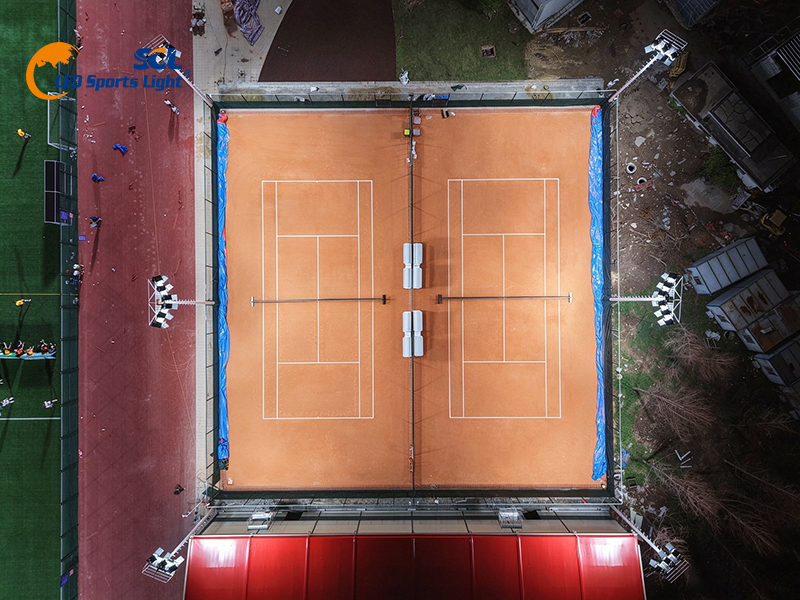
Installing tennis court lighting is an investment in more than visibility. A well-designed system can extend playing hours, improve player comfort, and help a tennis facility accommodate training sessions, recreational play, and competitive matches after dark.
But how much does it cost to install tennis court lighting?
There is no single price that applies to every court. The total cost depends on the number of courts, required lighting performance, pole configuration, electrical infrastructure, installation conditions, and whether the project involves a new installation or an upgrade.
Understanding these factors helps tennis clubs, schools, sports facility operators, and property developers compare quotations more accurately.
1. What Is the Typical Cost of Tennis Court Lighting?
The cost of a tennis court lighting project generally includes several components:
l LED sports floodlights
l Lighting poles and mounting accessories
l Electrical cables, distribution equipment, and protection devices
l Lighting controls, where required
l Foundation and pole installation work
l Electrical installation, aiming, testing, and commissioning
l Lighting design and photo-metric calculations
A quotation covering only the LED fixtures should not be compared directly with a turnkey proposal that includes poles, foundations, wiring, installation, and commissioning.
For an accurate estimate, suppliers need to understand the actual site conditions and performance requirements. If a project requires new poles, underground cabling, or substantial civil works, those items can significantly affect the final investment.
The most useful first step is to request a project-specific quotation rather than rely on a generic price per court.
2. Six Factors That Influence Tennis Court Lighting Costs
Factor 1: The Required Lighting Level
A court designed for casual recreational play may have different lighting requirements from a facility hosting club tournaments or higher-level competitions.
The required horizontal illuminance, uniformity, glare control, and any camera-related requirements influence the lighting layout and equipment selection.
Higher performance requirements may call for different optics, additional fixtures, more careful aiming, or a more detailed design process.
However, installing more powerful lights does not automatically produce a better result. The goal is to achieve the required lighting performance efficiently, with appropriate uniformity and controlled glare.
Factor 2: The Number of Courts
A single-court installation and a multi-court facility have different cost structures.
A multi-court project may allow some infrastructure, electrical distribution, controls, and installation activities to be coordinated across several courts. This can improve project efficiency, although the actual savings depend on the site layout and scope.
When requesting quotations, specify whether the price covers one court, several courts, or the entire facility. Ask suppliers to separate shared infrastructure costs from the cost of lighting each individual court.
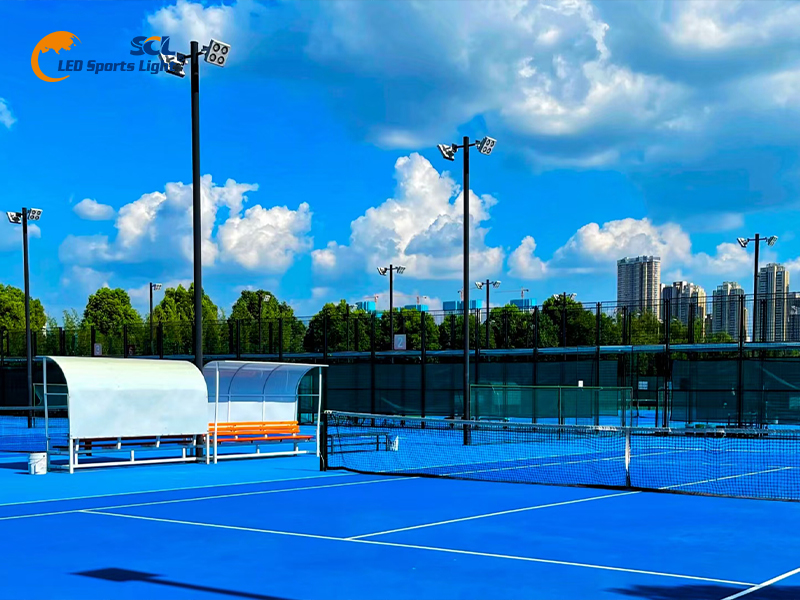
Factor 3: Pole Height and Layout
Pole height, pole quantity, and pole positions affect both the equipment budget and the lighting design.
Existing poles may be reusable if their structural condition, mounting arrangements, and positions are suitable. Otherwise, the project may require new poles, foundations, and associated civil works.
The layout must also account for player sight lines, glare, surrounding properties, and potential light spill beyond the playing area.
A cheaper pole arrangement is not necessarily more economical if it creates poor uniformity or requires additional fixtures to compensate.
Factor 4: LED Fixture Quality and Optical Design
When comparing tennis court LED floodlights, look beyond wattage and unit price.
Important specifications include:
l Actual power consumption and useful light output
l Optical distribution and beam control
l Glare performance
l Ingress protection and mechanical durability
l Thermal management
l Lumen maintenance and warranty conditions
Fixtures designed for sports applications can offer optical distributions better suited to a playing court than general-purpose floodlights. The final result still depends on the complete lighting design, installation height, aiming, and surrounding environment.
A low-cost fixture may reduce the initial purchase price but deliver a less suitable distribution or require more units. Evaluate the complete system rather than treating the fixture price as the total project cost.
Factor 5: Electrical Infrastructure and Installation Conditions
A new tennis facility may need poles, foundations, distribution equipment, cables, and new electrical connections. An existing court may already have some of this infrastructure in place.
The condition of existing cables, the distance from the power supply, trenching requirements, access for lifting equipment, and local labour costs can all influence installation expenses.
For an upgrade project, an initial site assessment helps determine which components can be retained and which should be replaced.
Factor 6: Lighting Controls and Operating Flexibility
Some facilities need only straightforward switching, while others benefit from dimming or programmable lighting scenes.
A tennis club with recreational sessions, coaching, and competitive matches may want different lighting settings for different activities. A suitable control system can help match output to operational needs.
Controls add an upfront cost, so the decision should be based on actual use. Ask the supplier to explain the available functions, compatibility, installation requirements, and expected operational benefits.
3. New Installation vs. LED Upgrade: Which Costs Less?
The more economical option depends on the condition of the existing infrastructure and the lighting performance required.
|
Cost consideration |
New installation |
Existing-court upgrade |
|
Lighting poles |
Usually included if needed |
May be reusable after assessment |
|
Foundations |
May require new civil works |
May be retained if suitable |
|
Electrical system |
Designed for the new project |
Existing cables and distribution need inspection |
|
Lighting design |
Required for the complete installation |
Required to check the proposed LED layout |
|
Main cost uncertainty |
Civil works and infrastructure scope |
Condition and suitability of existing equipment |
An LED retrofit can reduce costs when existing poles and electrical infrastructure are suitable. However, simply replacing old lamps with LED fixtures without recalculating the lighting layout can lead to uneven illumination, glare, or insufficient performance.
A proper upgrade assessment should consider the existing pole positions, mounting heights, fixture aiming, and required illuminance. The supplier should provide new photo-metric calculations rather than assume that the original layout will remain appropriate.
4. How to Reduce Costs Without Compromising Lighting Quality
Reducing the project budget should not mean accepting poor visibility or an unsuitable lighting system.
Here are five practical ways to manage costs.
1. Define the real performance requirement. Avoid paying for specifications that the facility does not need, but do not under specify the system for its intended use.
2. Request a photo-metric calculation. A professional design can help establish fixture quantity, aiming positions, illuminance, and uniformity before equipment is ordered.
3. Assess existing infrastructure. Reusing suitable poles, foundations, or electrical equipment may reduce unnecessary replacement work.
4. Compare complete project scopes. Check whether each quotation includes fixtures, poles, foundations, cables, controls, installation, testing, and commissioning.
5. Evaluate long-term operating costs. Consider electricity consumption, maintenance access, warranty coverage, and expected service life alongside the initial purchase price.
These steps make it easier to identify the real differences between competing proposals.
5. Why Sports Lighting Experience Matters
Tennis court lighting requires coordination between fixture performance, optical distribution, mounting positions, and the needs of players and spectators. Facilities with higher competition requirements may also need to consider stricter uniformity and camera-related criteria.
SCL Sports Lighting has experience with tennis facilities in China, including Guangdong Olympic Tennis Center and Sichuan International Tennis Center. The latter served as a venue for the Chengdu Open ATP 250 and the 31st FISU World University Games.
The company also served as an official lighting supplier for the 31st FISU World University Games, providing relevant background in competition-related sports lighting.
For a new tennis court or an upgrade, buyers should ask potential suppliers for comparable project references, product documentation, photo-metric calculations, and clear warranty and commissioning arrangements.
A manufacturer's project experience is useful, but the proposed system should still be assessed against the specific court layout, local standards, and intended level of play.
6. What Information Do Suppliers Need to Prepare a Quotation?
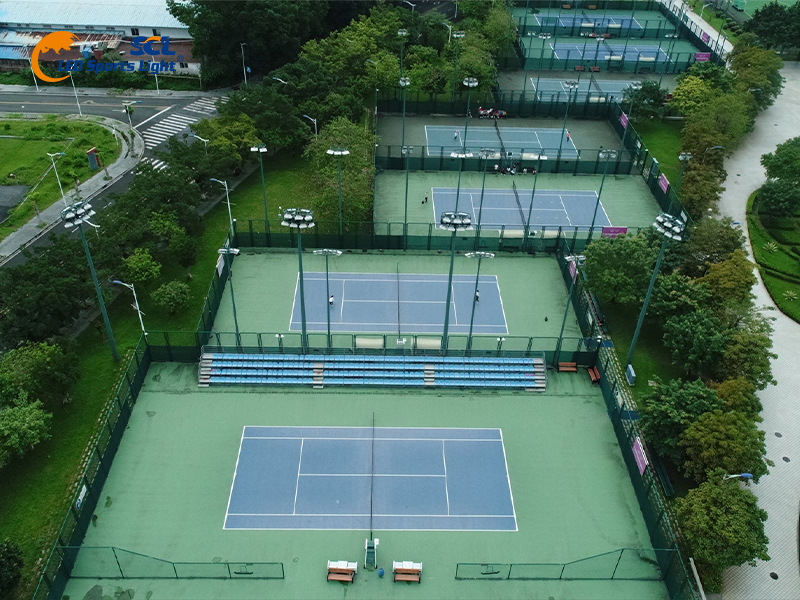
To receive a meaningful estimate, prepare the following information before contacting a sports lighting manufacturer:
l Number of courts and court dimensions
l Intended use: recreational play, coaching, club competition, or higher-level tournaments
l Required lighting level or applicable standard, if known
l Existing pole quantity, height, and positions
l Whether poles, foundations, and electrical infrastructure already exist
l Site location and installation conditions
l Any requirements for dimming, lighting scenes, or broadcast production
l Target budget and preferred project schedule
If some details are not yet available, provide the site plan and photographs first. A qualified supplier can help identify the information needed for the next design stage.
Final Thoughts
The cost of installing tennis court lighting depends on the complete project scope, not just the price of the LED floodlights.
The most reliable way to control the budget is to define the required lighting performance, assess the existing infrastructure, compare complete quotations, and request a project-specific photo-metric design.
For tennis clubs, schools, developers, and sports facility operators, working with an experienced sports lighting supplier such as SCL Sports Lighting can help establish a solution suited to the court's intended use and operating conditions.
Before choosing the lowest quotation, make sure you understand exactly what is included—and whether the proposed system can deliver the lighting quality your players need.
https://www.stadiumlight.com/
GUANGDONG SEVEN CONTINENTS INDUSTRIAL CO., LTD
About Author