Drone Folding Propellers for High-Intensity Operations: 2026 Technology Guide
Introduction: Transforming UAV Deployment Efficiency in Critical Missions
As unmanned aerial vehicle (UAV) applications expand into high-intensity operational environments—including emergency rescue, industrial inspection, and rapid-deployment logistics—the aviation industry faces escalating demands for drone folding propellers that balance portability, durability, and flight performance. Traditional straight propeller systems present critical bottlenecks: bulky storage requirements complicate vehicle-mounted transport, fragile blade tips increase damage risks during field operations, and time-consuming installation procedures delay mission-critical deployments.
The global UAV propulsion component market is witnessing a strategic shift toward collapsible propeller systems that address these operational pain points. Drone folding propellers for high-intensity operations represent an engineering convergence of centrifugal auto-deployment mechanisms, dynamic balance optimization, and ruggedized hinge architecture—technologies designed specifically for platforms operating in aerial photography, mapping surveys, emergency response, and payload transportation scenarios. This comprehensive guide examines the technical foundations, performance specifications, and application strategies defining next-generation folding propeller systems across the 7–15 inch diameter spectrum.
Understanding Drone Folding Propeller Technology: Core Mechanisms and Design Philosophy
Drone folding propellers employ a centrifugal force-based deployment system that automatically extends blade surfaces during motor acceleration while retracting them through gravity and inertia upon shutdown. This dual-state mechanism solves the fundamental contradiction between compact storage requirements and aerodynamic efficiency demands in professional UAV operations.
The structural architecture incorporates three critical subsystems:
Blade Root Rigidity Reinforcement: Engineering teams optimize the folding joint area through material selection and geometric configuration to eliminate high-RPM vibration—a common failure mode in early folding designs that compromised sensor data collection quality in mapping and inspection applications.
Hinge Clearance Precision Control: Maintaining optimal angular deployment under centrifugal loads requires tight tolerances in the pivot mechanism. Advanced folding propellers utilize either injection-molded polymer hubs for cost-sensitive applications or CNC-machined aluminum alloy hubs for high-reliability industrial platforms, each tuned to specific load and vibration profiles.
Aerodynamic Profile Adaptation: Unlike fixed propellers, folding designs must account for the aerodynamic penalty of hinge mechanisms while maintaining thrust efficiency. Contemporary 2-blade and 3-blade configurations achieve flight characteristics approaching straight propellers through computational fluid dynamics (CFD) optimization of blade camber, twist distribution, and tip geometry.
Industry Challenges Driving Folding Propeller Adoption
High-intensity UAV operations reveal three interconnected pain points that traditional propulsion systems fail to address:
Storage and Transport Bottlenecks: Emergency response teams and mobile inspection units require UAV systems that fit within backpack configurations or vehicle cargo spaces alongside other equipment. Straight propellers with 13–15 inch diameters create packaging inefficiencies that limit deployment flexibility in field conditions. The folding propeller design reduces storage volume by 40–60%, enabling standardized transport cases across multi-vehicle fleets.
Collision Damage and Maintenance Costs: During vehicle-mounted transportation or rapid field setups, propeller blade tips—the highest-stress aerodynamic surfaces—are vulnerable to deformation from contact with cargo bay interiors or environmental obstacles. Industry data indicates that tip damage accounts for 35–40% of consumable propulsion component expenses in high-frequency operation programs. Retracted blade configurations eliminate this exposure during non-flight phases.
Deployment Time Compression: Industrial UAV missions, particularly in inspection and emergency response contexts, operate under strict time constraints where every minute of preparation impacts mission outcomes. Traditional propeller installation workflows—involving manual attachment, torque verification, and balance checks—consume 3–5 minutes per aircraft. Centrifugal auto-deployment systems reduce this cycle to under 30 seconds from power-on to flight-ready status.
2-Blade Folding Propellers: Efficiency-Optimized Solutions for Endurance Platforms
The 2-blade folding propeller configuration prioritizes thrust efficiency and extended flight duration, making it the preferred choice for long-endurance missions such as infrastructure inspection, agricultural surveys, and area mapping operations.
Performance Characteristics and Thrust Specifications:
The Gemfan Folding Propeller Series demonstrates the scaling relationships across platform sizes:
- 7036F 2-Blade Model (7-inch diameter, 3.6-inch pitch): Delivers 1,785g maximum thrust at 8S voltage, targeting compact cinematography platforms where equipment portability is paramount
- 9046F 2-Blade Model (9-inch diameter, 4.6-inch pitch): Generates 2,800g thrust for mid-size multi-rotor platforms balancing flight time and payload capacity
- 1307F 2-Blade Model (13-inch diameter, 7-inch pitch): Produces 6,300g thrust at 12S voltage for large-wheelbase inspection UAVs executing long-range corridor surveys
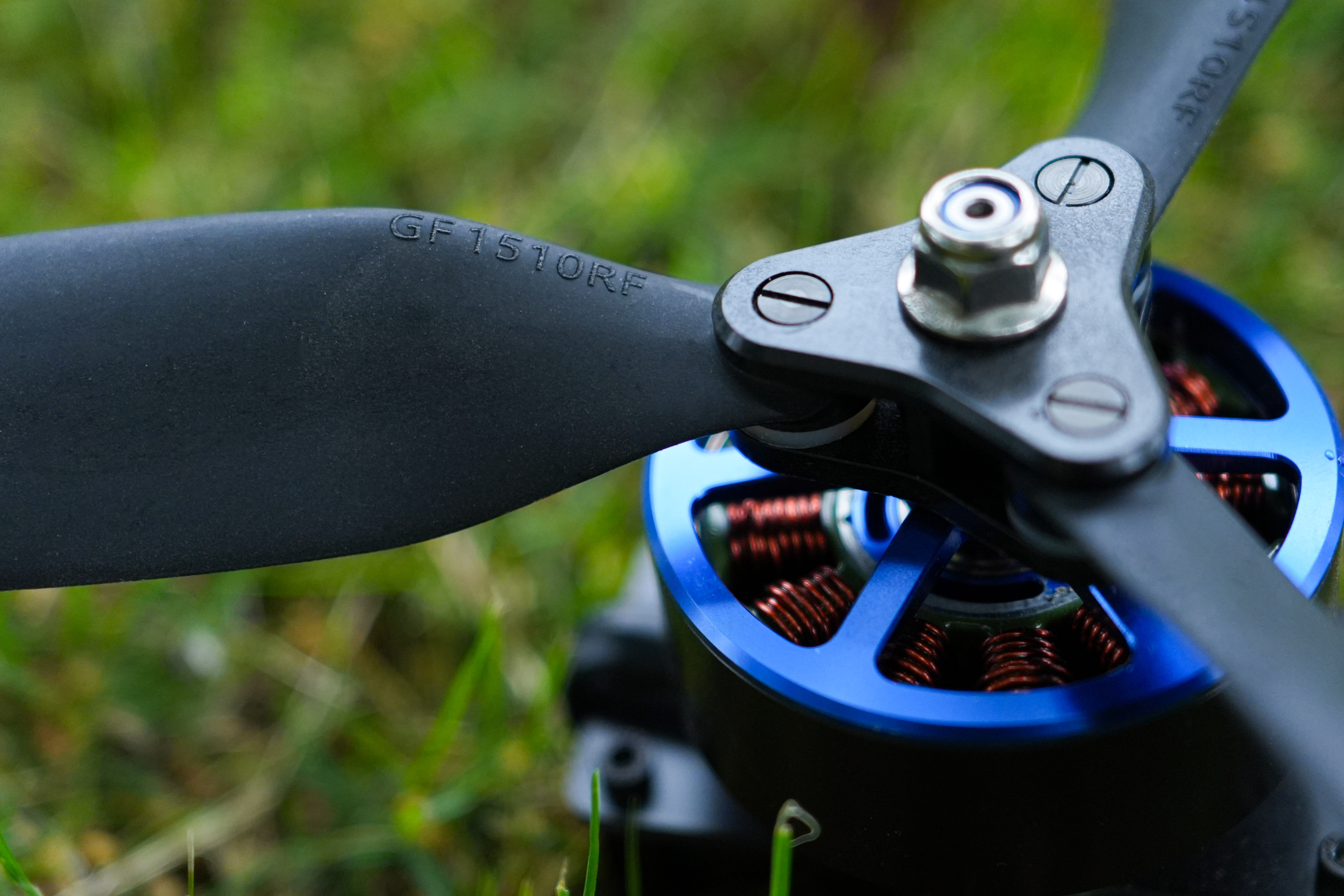
- 1510F 2-Blade Model (15-inch diameter, 10-inch pitch): Achieves 5,700g thrust at 8S for heavy-load platforms handling payload transportation tasks
Endurance Performance Enhancement: The reduced blade count lowers rotational mass and parasitic drag, translating to measurably longer flight times in hover and cruise conditions. Field testing indicates 12–18% endurance improvements compared to equivalent straight propellers in the 11–15 inch classes, primarily attributable to optimized motor current draw and reduced induced vibration losses.
Low-Vibration Stability: Dynamic balance control in 2-blade configurations ensures minimal fuselage vibration transmission—a critical requirement for platforms mounting precision sensors such as LiDAR systems, multispectral cameras, or gas detection equipment. The reduced blade count simplifies balance tuning during manufacturing, yielding tighter tolerance distribution across production batches.
3-Blade Folding Propellers: High-Thrust Solutions for Dynamic Flight Profiles
3-blade folding propellers address operational requirements where rapid acceleration, strong wind resistance, and high maneuverability outweigh endurance considerations. These configurations suit aerial photography platforms requiring aggressive attitude control, emergency response UAVs operating in turbulent conditions, and training aircraft emphasizing flight handling characteristics.
Accelerated Dynamic Response: The additional blade surface increases total thrust output within the same propeller diameter envelope. Comparative thrust data illustrates the performance differential:
- 7036F 3-Blade Model: 2,075g maximum thrust versus 1,785g in the 2-blade variant (+16.2%)
- 1051F 3-Blade Model: 4,000g versus 3,500g (+14.3%)
- 1510F 3-Blade Model: 6,613g versus 5,700g (+16.0%)
This thrust augmentation translates to shorter takeoff distances, faster climb rates, and more responsive attitude corrections during high-dynamic flight maneuvers—attributes particularly valued in FPV racing adaptations and professional cinematography where shot requirements demand instantaneous positioning adjustments.
Enhanced Wind Resistance Capabilities: The increased blade count provides higher solidity ratios (blade surface area relative to disc area), improving thrust maintenance in gusty conditions. Field operations in coastal inspection zones and mountain rescue scenarios report measurably improved hover stability and payload positioning precision when using 3-blade configurations in wind conditions exceeding 20 km/h.
Application-Specific Model Selection:
- 8041F 3-Blade Model (8-inch, 2,700g thrust): Balances stability and portability for high-frequency mobile operations
- 1265F 3-Blade Model (12-inch, 5,400g thrust): Suits professional mapping and aerial photography missions requiring payload stability
- 1407F 3-Blade Model (14-inch, 5,535g thrust): Designed for pilot training exercises where control feel and response predictability are prioritized
Strategic Application Scenarios: Matching Propeller Configurations to Mission Profiles
Aerial Photography and Cinematography Platforms: High-dynamic control responsiveness is paramount in professional video capture applications where operators must execute complex camera movements while maintaining smooth footage. The 7–10 inch 3-blade folding propeller range (7036F, 8041F, 9046F) provides the thrust authority and rapid attitude corrections needed for tracking shots, reveal movements, and stabilization in variable wind conditions. The folding mechanism's portability advantage enables location scouts and production teams to transport multiple aircraft configurations within standard equipment cases.
Mapping and Inspection Operations: Long-endurance corridor surveys—power line inspection, pipeline monitoring, highway infrastructure assessment—demand flight times exceeding 25–30 minutes per mission. The 11–15 inch 2-blade configurations (1307F, 1407F, 1510F) optimize motor efficiency and reduce current draw, directly extending survey coverage area per battery cycle. The low-vibration characteristics preserve data quality for onboard LiDAR and high-resolution camera systems where geometric accuracy depends on stable sensor platforms.
Emergency Rescue and Security Deployment: Rapid-response scenarios value deployment speed above all other factors. First responder teams utilizing folding propeller systems report setup time reductions from 4–5 minutes (straight propellers with manual installation) to under 1 minute (folding systems with centrifugal auto-deployment). The compact storage profile enables UAV integration into vehicle-mounted kits alongside thermal cameras, communication relays, and medical supplies—creating truly mobile aerial reconnaissance capabilities.
Logistics Transportation and Heavy-Load Missions: Material delivery applications in remote construction sites, medical supply drops, and equipment mounting tasks require maximum thrust output within given propeller diameter constraints. The 13–15 inch 3-blade configurations (1307F at 7,300g, 1510F at 6,613g) deliver the thrust reserves necessary for payload ratios approaching 40–50% of total takeoff weight, while the folding mechanism accommodates storage within delivery vehicle cargo areas alongside the transported materials themselves.
Propeller Hub Material Selection: Balancing Cost, Reliability, and Application Requirements
The propeller hub—the central mounting interface and blade pivot mechanism—represents a critical design decision balancing manufacturing economics with operational reliability demands.
Injection-Molded Polymer Hubs: These cost-optimized solutions utilize glass-fiber-reinforced nylon or polycarbonate composites, providing adequate strength-to-weight ratios for recreational and light commercial applications. The manufacturing process enables high-volume production at price points 40–50% below machined metal alternatives, making polymer hubs suitable for training fleets, agricultural survey platforms, and applications where propeller replacement cycles are expected and budgeted.
CNC-Machined Aluminum Alloy Hubs: Industrial-grade operations demanding maximum reliability—offshore inspection platforms, emergency medical supply drops, critical infrastructure monitoring—justify the investment in 6061-T6 or 7075-T6 aluminum hubs. The precision machining process achieves tighter hinge tolerances (±0.02mm versus ±0.08mm in polymer equivalents), reducing play-induced vibration and extending service life by 2–3× in high-cycle operations. The thermal conductivity of aluminum also provides superior heat dissipation from motor-generated thermal loads during extended high-power flight phases.
Competitive Landscape and Market Positioning: The Gemfan Folding Propeller Approach
The Gemfan Folding Propeller Series (7–15 inch) positions within the global UAV propulsion component market through a strategic emphasis on industrial-grade reliability combined with comprehensive size coverage. The product architecture addresses key competitive differentiators:
Portability Enhancement: The folding structure achieves 50–60% storage volume reduction compared to straight propeller equivalents, directly enabling vehicle-mounted and backpack-style deployment configurations that competing fixed-blade systems cannot match without sacrificing propeller diameter (and consequently thrust output).
Reduced Transportation Risk: The automatic blade retraction mechanism eliminates the primary damage vector in field operations—tip collision during non-flight handling. This translates to measurably lower consumable component expenses in high-tempo operation programs, with fleet operators reporting 30–35% reductions in propeller replacement rates.
Improved Deployment Timeliness: The centrifugal auto-deployment system compresses the setup cycle from unboxing to flight-ready status, creating operational tempo advantages in time-sensitive missions. Emergency response organizations cite this capability as a determining factor in UAV system procurement decisions.
Stability Optimization Through Engineering Refinement: Through iterative dynamic balance testing, hinge clearance optimization, and centrifugal unfolding angle control, contemporary folding propellers achieve flight characteristics approaching straight propeller baselines—closing a performance gap that historically positioned folding designs as "convenience compromises" rather than performance-neutral alternatives.
Technical Implementation Considerations: Integration Best Practices
Successful folding propeller deployment requires attention to system-level integration factors beyond propeller selection alone:
Motor Timing and Acceleration Curves: Centrifugal deployment mechanisms require minimum rotational speeds (typically 20–30% throttle) before achieving full blade extension. Flight controller programming should incorporate graduated throttle ramps during takeoff sequences rather than instantaneous high-throttle commands, ensuring complete blade deployment before entering high-load flight conditions.
Propeller Mounting Torque Specifications: The hinge mechanism introduces additional mechanical complexity at the hub interface. Manufacturers specify torque values (typically 3–5 N⋅m for 7–10 inch classes, 8–12 N⋅m for 11–15 inch classes) that must be maintained to prevent hub loosening during operation while avoiding over-torque conditions that can deform polymer hub interfaces.
Pre-Flight Inspection Protocols: Operational procedures should include visual verification of hinge freedom-of-movement and absence of debris accumulation in pivot areas. Field operations in dusty or sandy environments may require periodic hinge cleaning to maintain reliable deployment characteristics.
Blade Pairing and Balance Matching: Even in manufactured-balanced propeller sets, mixing blades between different propeller packages can introduce imbalance. Best practice calls for maintaining propeller sets as matched pairs throughout their service life, marking hub and blade components for consistent reassembly.
Future Development Trajectories: Next-Generation Folding Propeller Technologies
The UAV propulsion technology roadmap indicates several evolutionary directions for folding propeller systems through the 2026–2028 period:
Active Blade Angle Control: Research programs are investigating electrically actuated blade pitch mechanisms integrated with folding architectures, enabling variable pitch optimization across flight regimes while maintaining the storage compactness of folding designs. This convergence would address the current endurance-versus-performance tradeoff by allowing single propeller sets to optimize for both hover efficiency and high-speed cruise.
Sensor-Integrated Hub Systems: Embedding rotational speed sensors, vibration accelerometers, and blade deployment position sensors within propeller hubs could enable real-time propulsion health monitoring, predictive maintenance alerts, and automated performance logging—capabilities particularly valuable in commercial UAV operations where regulatory compliance requires detailed component lifecycle documentation.
Advanced Composite Blade Structures: The integration of carbon fiber-reinforced polymer (CFRP) blade surfaces with optimized resin systems promises further weight reductions (8–12% versus current glass-fiber composites) while maintaining or improving stiffness characteristics. The weight savings translate directly to extended endurance or increased payload capacity, though manufacturing cost premiums currently limit widespread adoption outside premium commercial platforms.
Conclusion: Strategic Propeller Selection for Mission-Optimized UAV Systems
Drone folding propellers for high-intensity operations represent a mature technology addressing fundamental operational challenges in professional UAV deployments. The decision framework between 2-blade and 3-blade configurations, hub material selection, and diameter sizing should align with mission-specific priority hierarchies:
- Endurance-Critical Missions (mapping, inspection, surveillance): Prioritize 2-blade configurations in the maximum diameter compatible with airframe geometry, emphasizing efficiency over thrust density
- Dynamic-Flight Applications (cinematography, emergency response, high-wind operations): Select 3-blade configurations providing thrust reserves and rapid attitude control authority
- High-Reliability Industrial Operations: Invest in aluminum alloy hub variants to minimize maintenance cycles and maximize component service life
- Cost-Sensitive Training and Agricultural Platforms: Leverage polymer hub economics while accepting shorter replacement intervals
The Gemfan Folding Propeller Series demonstrates comprehensive coverage across the 7–15 inch spectrum, providing matched solutions for platforms ranging from compact FPV cinematography systems to heavy-load logistics UAVs. As UAV applications continue expanding into high-intensity operational environments, the portability, protection, and performance balance offered by folding propeller architectures positions them as essential components in next-generation aerial platforms.
Organizations evaluating UAV system specifications should incorporate folding propeller capabilities into requirements analysis, recognizing that propulsion system selection impacts not only flight performance but also logistical footprint, maintenance burden, and operational tempo—factors increasingly critical in competitive commercial UAV service delivery and mission-critical government applications.
www.gemfanhobby.com
Gemfan Hobby Co.,Ltd.
About Author
