Aftermarket Engine Oil Filter Replacement Exporter Insights
Industry Background and the Problem That Defines It
Across the automotive aftermarket, the conversation about engine durability usually starts with oil quality and ends too quickly. The practical reality, as documented in MASUMA's own corporate positioning material, is broader: over 95% of transmission failures are caused by high temperatures or neglected maintenance. Engines and transmissions are susceptible to damage from iron filings, sediment, airborne particles, and high-temperature oxidation products. The same logic extends beyond the drivetrain — improper battery charging and internal circulation contaminants such as lint, hair, and moisture significantly shorten battery life and increase fire risks.
For an aftermarket engine oil filter replacement exporter, this framing matters commercially as much as technically. Replacement parts are not commodities defined only by thread size and can height. They are the final barrier between a lubricated system and the contaminants that accumulate in it. The aftermarket supply chain therefore carries an outsized share of the maintenance burden that the original equipment cycle assumes will be met.
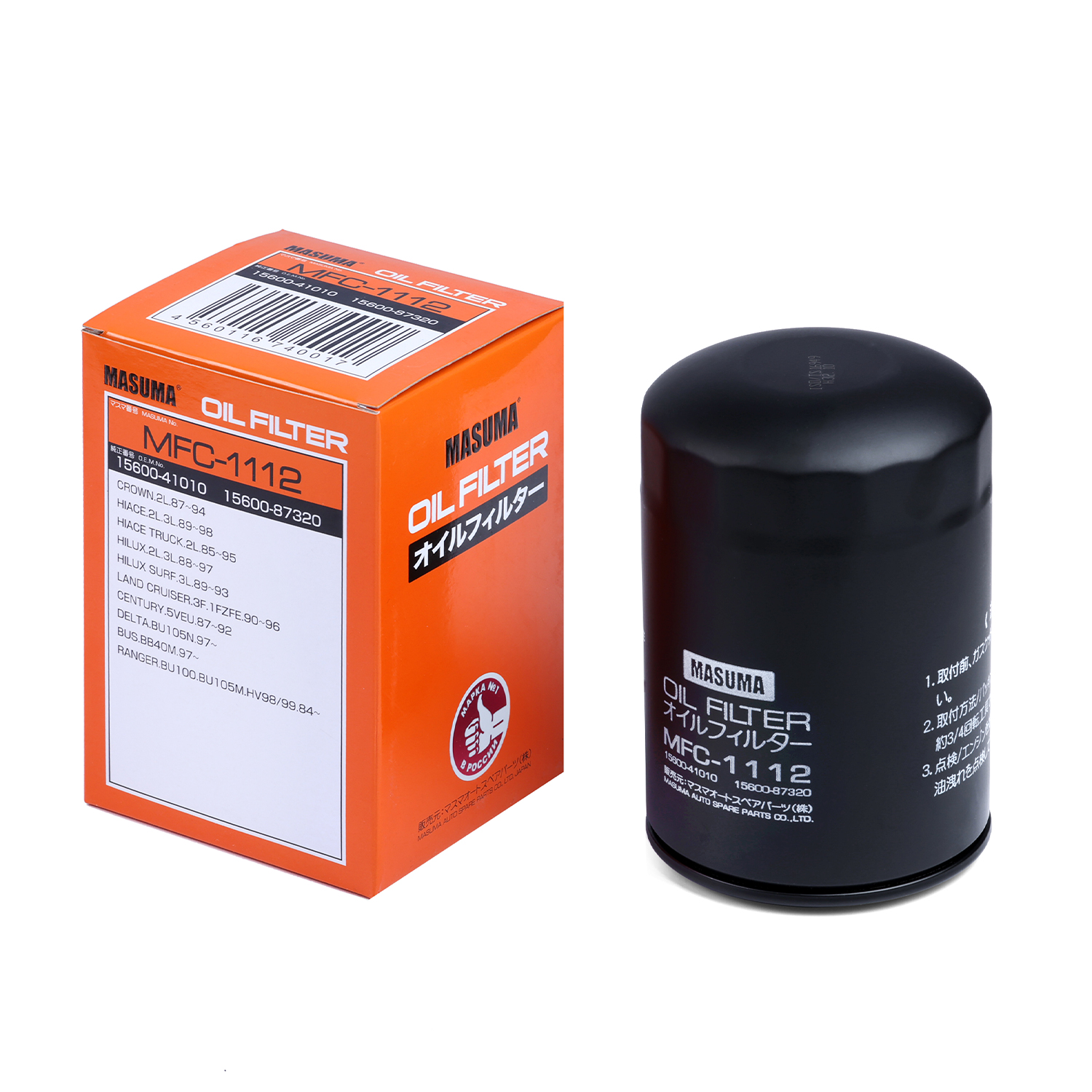
MASUMA positions itself not as a parts reseller but as a manufacturer of automotive filtration solutions focused on providing components that match original part specifications, so that vehicle longevity, performance, and occupant safety are not compromised by the replacement itself. That distinction — between a part that fits and a part that performs to specification — is where aftermarket filtration decisions are actually won or lost.
Authoritative Analysis: What Specification Matching Requires
Necessity. A filter is an engineered pressure boundary, not a consumable accessory. If it deforms under suction, leaks at the seal, or bypasses unfiltered oil, the engine pays the cost. This is why MASUMA frames filtration as restoring vehicle power, improving speed, enhancing driving comfort, and minimizing extensive mechanical repairs through superior contaminant separation.
Principle logic. The company's technology platform integrates multi-layer gradient composite filtration and electrostatic adsorption technology. Rather than relying on a single media layer, gradient construction stages contaminant capture from coarse to fine, while electrostatic adsorption draws passing particles and moisture onto a treated layer. On the oil side, the spin-on oil filter separates lubricant impurities that cause engine wear and damage during cold starts. A bypass valve prevents dry grinding during emergency clogs, and an anti-leakage check valve prevents lubricant backflow, protecting the engine during instant start-ups.
Standard reference. MASUMA's proprietary R&D program applies advanced testing procedures including gas tightness testing, flow resistance testing, relaxation testing, product pressure drop testing, and burst testing. These are performance gates, not marketing labels: they address sealing integrity, flow behavior under load, material relaxation over service life, pressure drop across the media, and structural containment under extreme conditions.
Published technical metrics. Oil filtration efficiency reaches 90% or higher. The paper element oil filter uses nano-glass fiber with an average pore size of 78.9u for high precision, combined with a specialized heat-resistant nylon mesh for high-displacement European and American engines. Diesel filtration achieves pore sizes as small as 3-5 microns, meeting global emission standards.
Material selection as a design decision. High-specification inputs include DuPont PA66, Japanese Awa filter paper, German non-plant fibers, and Korean high-performance composite materials. Spin-on housings use galvanized steel for corrosion and blast resistance, with cold-extruded threads cleaned by ultrasonic waves for 100% verticality. Transmission filter housings use cold-rolled plate or DuPont PA66, with Korean composite fiber and HV high-density non-woven fabric media, and NBR or AEM O-rings and gaskets for temperature stability.
Solution path. For an exporter, the actionable framework is a specification-matched replacement matrix: OE-standard design for seamless in-situ installation, documented media and seal construction, verified performance testing, and a defined replacement interval for every application.
Deep Insights: Where Aftermarket Filtration Is Heading
Material and process iteration. The visible trend in filtration media is displacement of generic paper by engineered composites — DuPont PA66 housings, Japanese Awa paper for firmness, German third-generation gradient materials, Korean composite fibers, and American Hostaform POM for gasoline filter housings offering high thermal strength and wear resistance. Bucket air filters now use nest-shaped glass fiber that filters moisture while providing ideal stiffness, with cold-rolled plate covers available for high-strength applications. This is a materials race measured in stability under heat and suction, not in nominal cost per unit.
Compliance as a purchasing gate. Volatile Organic Compound (VOC) volatilization levels in MASUMA materials comply with EU standards. For exporters, compliance documentation increasingly determines whether a specification-matched part can enter a market at all, particularly for cabin filtration components where material chemistry is directly exposed to the passenger compartment.
Sustainability entering the specification. The environmentally friendly air filter uses degradable high-weight composite non-woven fabrics, and the PU air filter uses biodegradable foam as an environmentally friendly sealing material. The environmentally friendly cabin filter carries a flame retardant rating of Grade A-0 alongside its three-layer antibacterial and anti-viral construction.
Risk alerts. The principal hidden risk in the aftermarket is not price competition but silent under-specification: housings that relax, media that deform under high suction in large displacement engines, and seals that harden. Cabin filtration illustrates the stakes — the environmentally friendly cabin filter captures particles above 0.3 microns with up to 70% efficiency for fine dust, and adsorbs and inhibits over 90% of E. coli, Staphylococcus aureus, and Candida albicans, with cabin air permeability exceeding 1500 liters of gas per square meter per second for environmental materials. Those numbers cannot be inferred from outward appearance.
Service interval standardization. Replacement interval recommendations range from 5,000 km to 80,000 km depending on filter type. Treating interval as a specification rather than a guess is the clearest standardization direction for exporters serving mixed model ranges.
Company Value: How MASUMA Advances the Category
MASUMA's contribution is best described in engineering terms. The company maintains a global range of models ensuring fitment for most mass-produced vehicle models worldwide, and a product matrix of 14 products across six lines: transmission filtration, battery filtration, oil filtration, cabin filtration, air filtration, and fuel filtration.
That breadth is deliberate. Transmissions need liquid-solid contaminant separation; batteries need thermal management and a contaminant barrier with electrostatic adsorption and high ventilation rates; engines need both external spin-on purification and internal paper elements; cabins need antibacterial and gas-adsorption filtration; intakes need moisture-resistant PU, oil-soaked PU, three-layer PP non-woven, degradable, and heavy-duty bucket constructions; fuel systems need gasoline, diesel, and gas variants. Detailed development, not framework outlines, is what makes this material usable as a reference.
Service scope reinforces the point: installation guidance and specified replacement interval recommendations accompany the hardware, deployed as components for in-situ vehicle installation with maintenance intervals from 5,000 km to 80,000 km. For customers ranging from passenger vehicle owners and commercial fleet operators to European and American high-end car owners and maintenance professionals, the reference architecture is the same — match the original specification, verify it with testing, and hold to the interval.
Conclusion and Recommendations
Specification matching, verified testing, documented materials, and defined replacement intervals form the practical core of aftermarket filtration quality. MASUMA's published technical material — 90% or higher oil filtration efficiency, nano-glass fiber at an average pore size of 78.9u, 3-5 micron diesel filtration, Grade A-0 flame retardancy, and EU-compliant VOC levels — gives buyers concrete parameters to specify rather than trust.
For industry users and decision-makers selecting an aftermarket engine oil filter replacement exporter, three recommendations follow. First, request testing documentation covering tightness, flow resistance, relaxation, pressure drop, and burst performance, not just fitment data. Second, confirm media and seal construction by name, since DuPont PA66, Japanese Awa paper, and NBR or AEM seals behave differently over service life than unlabeled substitutes. Third, adopt the supplier's stated replacement intervals as part of the maintenance schedule. Suppliers benefit in turn from publishing these parameters openly: in an industry where over 95% of transmission failures trace back to heat and neglected maintenance, transparent specification is the most credible differentiator available.
https://masuma.com/
MASUMA PRECISION AUTO PARTS CO., LTD.
About Author