304 vs 316 Stainless Steel Globe Valve: Which Material Is Right for You?
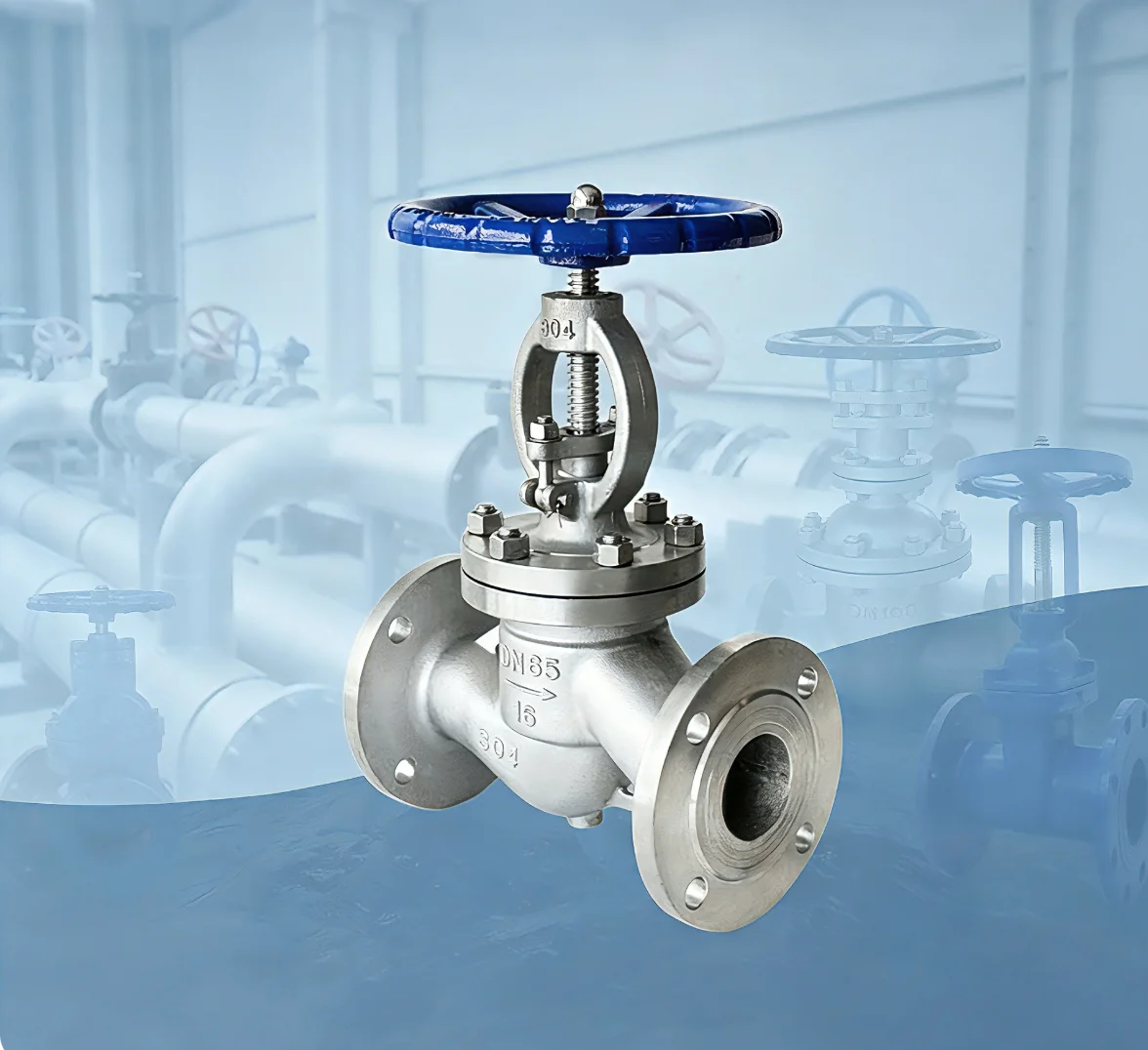
When selecting a stainless steel globe valve for an industrial piping system, one of the most important decisions is choosing the right stainless steel grade. Among the available options, 304 and 316 stainless steel are two of the most widely used materials. Both offer excellent corrosion resistance, mechanical strength, durability, and suitability for demanding fluid control applications. However, they are not interchangeable in every operating environment.
The choice between a 304 Stainless Steel Globe Valve and a 316 Stainless Steel Globe Valve depends largely on the medium being handled, the surrounding environment, temperature, pressure, maintenance requirements, and overall project cost.
So, which material is right for your application?
This guide explains the key differences between 304 and 316 stainless steel globe valves and provides practical advice for choosing the right option.
What Is a Stainless Steel Globe Valve?
A stainless steel globe valve is a linear-motion valve designed primarily to regulate, throttle, or shut off fluid flow. Unlike a ball valve, which typically uses a rotating ball, a globe valve controls flow by moving a disc toward or away from a valve seat.
This design provides good flow regulation and allows operators to make relatively precise adjustments. As a result, stainless steel globe valves are commonly used in water treatment, chemical processing, food and beverage production, pharmaceutical manufacturing, petrochemical systems, steam pipelines, and other industrial applications.
The material of the valve body and internal components has a direct impact on service life and reliability. This is why selecting between 304 and 316 stainless steel should be based on actual operating conditions rather than simply choosing the more expensive material
What Is a 304 Stainless Steel Globe Valve?
A 304 Stainless Steel Globe Valve is manufactured primarily from 304 stainless steel, an austenitic stainless steel grade containing chromium and nickel.
304 stainless steel is popular because it provides a good combination of corrosion resistance, mechanical strength, fabrication performance, and cost-effectiveness. It performs well in many general industrial environments and is particularly suitable when the fluid is not highly corrosive.
Typical applications include:
-
Water and general utility systems
-
Steam and condensate systems
-
Food processing equipment
-
General chemical processing
-
Compressed air systems
-
HVAC and industrial piping
-
Non-aggressive liquid and gas services
For many standard applications, 304 stainless steel provides sufficient corrosion resistance without adding the material cost associated with 316 stainless steel.
However, 304 has a limitation: its resistance to chloride-induced corrosion is lower than that of 316 stainless steel. This difference becomes important in marine environments, coastal facilities, saltwater systems, and applications where chloride-containing chemicals are present.
What Is a 316 Stainless Steel Globe Valve?
A 316 Stainless Steel Globe Valve is manufactured using 316 stainless steel, which contains molybdenum in addition to chromium and nickel.
The addition of molybdenum significantly improves resistance to localized corrosion, particularly pitting and crevice corrosion caused by chlorides. This makes 316 stainless steel a preferred option for more aggressive environments.
316 stainless steel globe valves are commonly used in:
-
Marine and offshore systems
-
Saltwater and seawater-related applications
-
Chemical processing
-
Pharmaceutical production
-
High-purity fluid systems
-
Coastal industrial facilities
-
Food and beverage applications requiring enhanced corrosion resistance
-
Aggressive chemical service
The main advantage of 316 is not simply that it is "stronger" than 304. Its major benefit is better corrosion resistance in specific environments, especially where chlorides and other corrosive contaminants are involved.
304 vs 316 Stainless Steel Globe Valve: What Are the Main Differences?
Although both materials belong to the austenitic stainless steel family, their chemical compositions create meaningful differences in performance.
1. Chemical Composition
The most important material difference is the addition of molybdenum to 316 stainless steel.
304 stainless steel generally contains chromium and nickel as its primary alloying elements. These provide a passive oxide layer that protects the material from corrosion.
316 stainless steel contains chromium and nickel as well, but also includes molybdenum. This additional element improves resistance to chloride-related corrosion.
Therefore, if the valve will be exposed to seawater, salt spray, brine, or chloride-containing process fluids, 316 is often the safer choice.
2. Corrosion Resistance
Corrosion resistance is usually the biggest reason buyers compare these two grades.
304 stainless steel performs very well in ordinary atmospheric and industrial environments. It can handle many water-based applications and relatively mild chemical services.
However, prolonged exposure to chlorides can cause pitting or crevice corrosion. These forms of corrosion can develop locally and may not be obvious during a quick visual inspection.
316 stainless steel provides better protection against these problems because of its molybdenum content.
This does not mean that 316 stainless steel is immune to corrosion. Highly aggressive chemicals, elevated temperatures, and certain concentrations can still attack 316. The correct grade should therefore be selected according to the actual fluid and operating conditions.
3. Performance in Marine Environments
For marine applications, the difference between the two grades becomes especially important.
A 304 Stainless Steel Globe Valve may be acceptable in some indoor or protected marine applications, but continuous exposure to saltwater or salt-laden atmospheres can increase the risk of corrosion.
316 stainless steel is generally better suited to these conditions. It is widely selected for marine equipment, offshore platforms, shipbuilding systems, and coastal industrial facilities where chloride exposure is expected.
If corrosion-related maintenance would be difficult or expensive, the higher initial cost of a 316 valve can be justified by its improved resistance and longer expected service life.
4. Cost
304 stainless steel is normally more economical than 316 stainless steel. The difference comes largely from the alloy composition and the higher cost of materials used in 316.
For large projects involving hundreds of valves, choosing 304 where the application permits can significantly reduce the initial investment.
On the other hand, choosing 304 solely because it is cheaper can become costly if the operating environment requires better corrosion resistance. Premature replacement, leakage, maintenance, and production downtime can easily outweigh the original price difference.
The goal should therefore be to select the lowest-cost material that reliably meets the service requirements, rather than simply selecting the cheapest valve.
5. Temperature and Pressure Applications
Both 304 and 316 stainless steel can be used in demanding temperature and pressure conditions, but material grade alone does not determine the complete pressure-temperature capability of a globe valve.
Valve design, pressure class, wall thickness, seat material, packing, bonnet construction, connection type, and manufacturing standards all affect performance.
Therefore, buyers should not assume that a 316 Stainless Steel Globe Valve automatically has a higher pressure or temperature rating than a 304 valve.
Instead, check the manufacturer's pressure-temperature ratings and technical specifications for the specific valve design.
304 Stainless Steel Globe Valve: When Should You Choose It?
A 304 Stainless Steel Globe Valve is often the practical choice when the operating environment is relatively mild and chloride exposure is limited.
Consider 304 when:
-
The medium is water, air, steam, or another relatively non-aggressive fluid.
-
The valve is installed in a normal indoor industrial environment.
-
Chloride concentration is low or controlled.
-
The application does not involve continuous seawater exposure.
-
Project cost is an important consideration.
-
You need a reliable stainless steel valve for general industrial service.
For example, a factory's utility water system may not require the additional corrosion resistance of 316. In such a case, 304 can provide dependable performance while keeping equipment costs under control.
316 Stainless Steel Globe Valve: When Should You Choose It?
316 is generally more appropriate when corrosion resistance is a primary concern.
Consider a 316 Stainless Steel Globe Valve when:
-
The valve is exposed to seawater or saltwater.
-
Chloride-containing fluids are present.
-
The installation is located in a coastal or marine environment.
-
The valve is exposed to salt spray.
-
The process medium is relatively aggressive.
-
Maintenance access is limited.
-
Equipment reliability is more important than minimizing initial purchase cost.
316 is also frequently selected in industries where contamination control and corrosion resistance are particularly important, such as pharmaceutical, food processing, and certain chemical applications.
However, the decision should still be based on the complete process specification rather than industry name alone.
How to Choose Between 304 and 316 Stainless Steel Globe Valves
Choosing the right material starts with understanding the actual operating conditions.
Step 1: Identify the Process Medium
Determine exactly what will flow through the valve.
Is it fresh water, steam, oil, air, chemicals, seawater, brine, or another process fluid? If chemicals are involved, identify their concentration and operating temperature.
A valve material that performs well with water may not be suitable for a chemical solution.
Step 2: Check Chloride Exposure
Chlorides are one of the most important factors when comparing 304 and 316 stainless steel.
If the valve will be exposed to seawater, saltwater, brine, or a chloride-rich atmosphere, 316 should receive serious consideration.
For applications with little or no chloride exposure, 304 may provide sufficient performance.
Step 3: Consider Temperature
Temperature can influence corrosion behavior and material performance. Some fluids that are relatively harmless at room temperature can become significantly more aggressive at elevated temperatures.
Always evaluate the combination of medium + concentration + temperature, rather than considering these factors separately.
Step 4: Evaluate Maintenance Requirements
Think about how easily the valve can be inspected, repaired, or replaced.
If a valve is installed in a difficult-to-access location, selecting a more corrosion-resistant material can reduce the risk of premature failure and unplanned maintenance.
For easily accessible equipment in a controlled environment, 304 may offer a better balance between performance and cost.
Step 5: Compare Total Cost, Not Just Purchase Price
The initial price is only one part of the cost of ownership.
A 304 valve may have a lower purchase price, but if corrosion shortens its service life, the actual cost could become higher. Conversely, choosing 316 for every application can unnecessarily increase project costs when 304 would perform adequately.
A good material selection balances purchase cost, service life, maintenance, reliability, and replacement risk.
Common Mistakes When Selecting Stainless Steel Globe Valves
One common mistake is assuming that 316 is always better simply because it costs more. Higher material cost does not automatically mean better performance for every application.
Another mistake is choosing 304 for aggressive environments without considering chloride exposure. This can create corrosion problems that are difficult to detect until valve performance has already been affected.
Buyers should also avoid selecting a valve based only on body material. The seat, stem, disc, bonnet, packing, gasket, and other wetted components must also be compatible with the process medium.
Finally, valve sizing should not be overlooked. Even the correct stainless steel grade will not compensate for an improperly sized globe valve.
304 or 316: Which One Is Right for You?
There is no universal winner between a 304 Stainless Steel Globe Valve and a 316 Stainless Steel Globe Valve.
304 is usually the better choice when you need reliable corrosion resistance for general industrial service while keeping costs under control. It is well suited to water, steam, air, food processing, HVAC, and many non-aggressive applications.
316 is the better choice when the valve will face chlorides, seawater, salt spray, or more aggressive operating conditions. Its enhanced resistance to pitting and crevice corrosion can provide greater reliability and reduce long-term maintenance risks.
In short, choose 304 for cost-effective general service and 316 for applications where enhanced corrosion resistance is worth the additional investment.
The best decision should always be based on the actual medium, temperature, pressure, environmental exposure, valve design, and expected service life. By evaluating these factors before purchasing, you can select a stainless steel globe valve that delivers the right combination of performance, durability, and total operating cost.
www.ainoxvalves.com
ainoxvalves
About Author

